
Martin Luther King’s term, “Beloved Community,” points to our potential for living together with love, justice and respect. This talk is an expansion of Tara Brach‘s opening contribution to the “Beloved Community” program at BuddhaFest, 2015 (the corresponding article and link to video of the BuddhaFest program, including panel discussion with Rev. angel Kyodo williams Sensei, Femi Akinnagbe, Tara Brach and Eleanor Hancock, can be found here).
In this teaching, Tara explores the often hidden expressions of racism that fuel separation and violence, and pathways toward healing and freeing our collective hearts. This article is an adaptation of the original talk; link to audio at bottom of text.
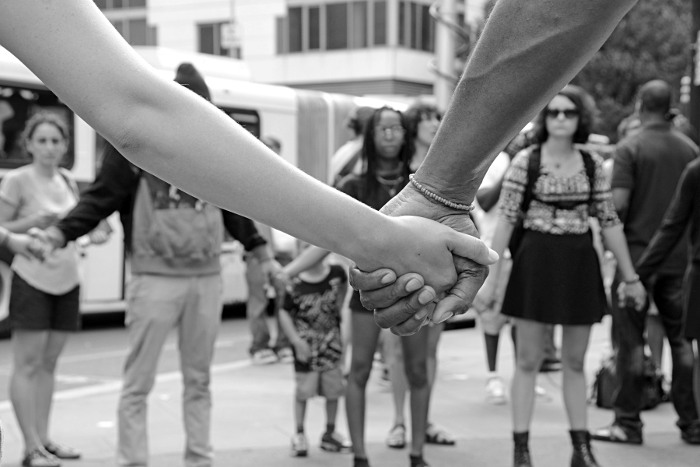
Photo: Lukas Maverick Greyson / Shutterstock.com
Part One: The Delusion of Separateness, and the Violation of “Other”
Part Two: The Current of White Privilege, and the Ghost of Racist Past
Part Three: Freeing Ourselves from the Prison of Separation
Part Four: Closing Meditation
Bio, and link to full audio of talk
Part One: The Delusion of Separateness, and the Violation of “Other”
So Sunday, at Buddha fest, the program we had was called “Beloved Community.” This is a phrase that Martin Luther King made popular. What it speaks to, for me, is the aspiration that we wake up from that which separates us and, in particular, that we wake up from the suffering of racism and live together in a way that’s truly respectful, loving, and equitable. The conference organizer set the stage by introducing those of us who would be the panel, and then, as he began to describe the topic, you could hear Siri’s voice saying very loudly, “Sorry, I didn’t quite catch that.” It was such an amazing way to start the program! I think you can understand why. This is how it is for us, when we begin to explore how we create separation, and we get a glimpse of it, a glimmer of how we create distance with each other and in our world, and then we turn away. We don’t quite get it. We don’t stay. We go back to our old habits and automatic identifications … we don’t quite catch it!
One way I understand beloved community is as our evolutionary potential. If we look at brain development over the eons, we see that the most recently emerged part of our brain, the frontal cortex, has this deep capacity, this whole neuro-net, for empathy, compassion, and what we might describe as an inclusive heart – that’s our potential.
Inclusive, loving community is an intrinsic part of the spiritual path: the vision, the aspiration, and the movement towards it. It was so for Martin Luther King, and it is part of the Buddhist tradition as well. In Buddhism beloved community is called “sangha.” Sangha means that we truly get our relatedness. We live from that place of deep respect and appreciation, this being-ness that shines through each of us. In the Buddhist teachings, there is no freedom possible unless we really get that interdependence and we really live with the sense of true belonging. It’s not like you can go off into a cave and get very very still and have these wild experiences and realizations if you don’t have that sense of being with others and sensing that these beings are part of my web of belonging.
I often refer to a verse from Rumi, which really says that our path isn’t to seek for love, but to seek and find the barriers that we’ve erected against it. This is a very deep theme in spiritual life, that the loving and the awareness are already here. We have conditioning that stops us from inhabiting it, and that’s what we’re going to look at together tonight. What is that conditioning. And we’re going to look not only at individual conditioning, but what it is in our collective psyches that stops us from really feeling beloved community. And I’d like to, in this class, shine a particular lens on the separation we create through racism. For me, this inquiry is deeply personal, immediate, and alive. It’s not something about which I can say, “Oh, yeah I looked at that and worked through that one.” It’s very alive for me. And I’m very aware of the depth of the challenge.
I’d like to start broadly, looking at how the sense of separation is created generally, and then narrow the focus. The broadest way to start is the existential sense of separation that every living organism has. Every living organism has some perception of “in here is self” and “out there is universe”, and integral to survival is the need to protect and further the self. Einstein calls it an “optical illusion of separateness.” Most of you are familiar with that, the way he describes it. It’s very useful, and it’s universal. It’s not like it’s a mistake – all creatures have this sense.
Einstein describes this sense of separation as a prison because the primal mood of the separate self is fear. To the degree that you feel separate, there is fear. There’s also craving, the flip side of fear. I often describe this state as a trance: the sense of self in here, and other out there. In this trance we are organized around defending and getting. That which is outside of “self” is viewed as what I call the “unreal other.” You can’t see the reality of another person when you’re feeling separate. You can’t sense the subjectiveness of the sentience of who’s really there. So what happens, when another is unreal to us, is that the more stressed we are, the more the unreal the “other” becomes. And the more that another is unreal, the more we can violate them.
So this is the broadest sense in which we can discuss the experience of separate self. We can also look at separateness in terms of human evolution. Up until about ten thousand years ago, humans ran around in small bands, maybe 8-15 people. It was life or death to recognize who was your “in-group” and who was the “other.” We lived in these little bands that were surviving by having in group and out group for much longer than we’ve been in more current forms of community. This evolutionary pattern makes a deep impression on our psyches. There’s an in-group and an out-group and we are trained to look for these differences.
When we move from this deep evolutionary history to more modern history, and look at the last several hundred years, we can see this in-group, out-group view at work. These last several hundred year have been dominated by European colonization. From the Eurocentric world view, white is “in” and everyone else is “out” – you have a white centered world for the dominant group. And the white, Eurocentric worldview has been marked by a growing individualism within the ego.
Carl Jung describes a very interesting dialogue he had in 1924 with an American Indian chief. The chief was describing to white men. “Their eyes have a staring expression,” he said. “They’re always seeking something. What are they seeking? The whites always want something. They’re always uneasy and restless. We don’t know what they want. We don’t understand them. We think they’re mad.” Jung asked why the chief thought white men were mad and his response was: “They say they think with their heads.” Jung was surprised and asked, “Well, what do you think with?” And the chief’s response was, “We think here” – and he pointed to his heart.
This conversation had a profound effect on Jung. You can see it in his writings. The truth is that when we think with our heads, and we’re not connected to our hearts, we’re dominated by fear, by a sense of separateness, the need to posses, violate, and dominate. It’s not until we evolve to use these good minds, but have them informed by our hearts, that we can have access to relatedness and beloved community.
This chief was pointing to a Western, white mentality that is a collective identity. There is a certain madness in it, which is the way he put it. A certain tendency to violate and dominate, and how else can we understand, first of all, the violation of planet earth? How could it have happened if we were connected to our hearts? But more to the theme of tonight, how else can we understand racism, and the history of European colonialism? I want to talk about what this madness translated into in the United States. How, in just a few hundred years, we decimated the indigenous people of this continent, we kidnapped and enslaved people from another continent, and we created an ongoing system of oppression of these people on the basis of a distinction of skin color. All in just a few hundred years. That’s that madness. That’s that collective psyche that thinks that in some way, white is the “in-group” and anything can be done to the “other.”

Photo: Roman Königshofer
Part Two: The Current of White Privilege, and the Ghost of Racist Past
What happens when you have 200 years of this kind of violence and oppression, where white people are dominating? What happens to the psyche? This represents trauma. Most of us understand the individual effects of trauma. We even get it generationally, that if someone has been traumatized, that’s gonna effect other generations. If we look at it in terms of what happens, the experience of being perpetrators and the experience of being dominated or oppressed, we can see how this continues over generations and effects everybody involved.
One of the things I’ve noticed, when the subject of racism comes up, is how white people (especially liberal white people) will say, “Oh yeah this is an important thing,” but the sense is that it doesn’t really involve me, or my life, or my spiritual path. And yet, you can’t be in a field of humans where there’s been trauma and not be involved. We’re all involved. Slavery in it’s formal expression, doesn’t exist, but there’s new versions now, and there have been new versions over time; we can see it in education, access to resources, access to jobs. There are twice as many blacks than whites who are unemployed. Twice as many. And we can see what is happening in terms of mass incarceration.
But the legacy of racism does not only effect access to resources in our society. It effects our psyche, and our very deep sense of identity. What that means is, if you’re the one who doesn’t have access, there’s a sense of inferiority, disempowerment, and threat. But what happens if you’re the one who has access? Here something interesting takes place: the identity gets more unconscious. There is an unconscious sense of privilege and superiority and of deserving and of taking what’s do. If you’re white, you might be in a group of people and describe people who are not white as, “yeah that’s an African American” or “that’s an Asian person.” But if you’re describing a white person, you don’t say, “Oh, that’s a white person.” Because it’s given that white is how it is, and everything else is different. Toni Morrison writes: “In this country, American mean white. Everybody else has to hyphenate.” Isn’t that true?
Living in a white dominate context, we get these constant messages. As white people, we experience our centrality in history text books and media advertising, in our teachers, role models, hero, heroines, everyday discourse about “good neighborhoods” and “good schools”, who’s in them and who’s not. We watch popular TV shows centered around friendship circles that are all white, and we are exposed to religious iconography that depicts God, Adam and Eve, and other key figures as white. What happens? If you’re white, you don’t really notice it, but if you’re not white you do.
This has all become really personal for me. Within about the last 8 years I’ve been on a very humbling, and amazing, spiritual journey. I’ve been sort of “peeling the onion” on all this, and becoming more and more aware of my own conditioning and lens, as a white person in America.
After beginning to watch my own assumptions for some time, I was on a trip with my husband one summer, and we were going for a swim. Our goal was to get to this island that was a little ways out. It was the first swim of the season for me, and I was a little nervous about how well my body would do. But I was amazed, when I got into the water, at how I got into this rhythm and I was really moving. I felt strong, athletic, balanced and good. I got to the island, took a little rest, then started back … and oh my god, I was winded and off balance! I didn’t feel strong or athletic anymore! And suddenly I realized that, on the way out to the island, I had been going with the current! But I didn’t know it. That, to me, was an incredible moment of realizing: “Oh, that’s white privilege – that’s white dominance!” The current supports you. You don’t notice how many doors open in this life for you. A deep part of it, in terms of the current, is the feeling of fitting in, the feeling of being part of the culture that’s on top. And it isn’t just in society out there, it plays out in spiritual communities every bit as much.
I wanted to share with you a blog post that a man wrote after coming to this class for the first time about four years ago. This is written by and African American man and he called it The Color of the Buddha Heart:
When I arrived, I was a little early, so I sat down at the end of the second row and began to read a book I had purchased awaiting for the meditation. The building slowly filled to capacity and it seemed that by the time the meditation had began, every seat in the house was filled except one – the one next to me. I became a little set off by this until the ghost of racist past sat down next to me. He said, “Empty seats are devoured in this hall, so why am I sitting next to you?”
His rap filled my mind with anger and frustration. I ignored and tried to focus on the meditation. I couldn’t. He said, “Why am I the only person to sit next to you? Do they think you’d rob them?”
“No, that’s absurd,” I replied. “I don’t think they felt that way.”
The ghost responded, “Well maybe you have an awful smell?”
“No I’m clean.”
“You look intimidating?”
“I don’t believe a 41 year old black man in dress pants and a button down creates fear and intimidation.”
“Is it because you’re new?”
“I don’t know.”
This situation bothered me for the rest of the evening to the point that I didn’t and couldn’t follow the rest of the dharma talk. I remember the teacher announcing that volunteers were needed with the tea and snack table. It was my intention to help out, but I thought to myself:
“They don’t want a black man to help.”
So right after the service was over, the ghost of racist past escorted me out.
So that was here, about four years ago. The unusual and beautiful end of the story is that he and I became friends, and he is now serving on IMCW’s board. So he didn’t go away. But that’s not what would usually happen. And I can understand why it wouldn’t. It’s painful to know that for all our best intentions, we’re missing an awareness of what it really means to carry a certain identity and how to be sensitive to the impact of that.
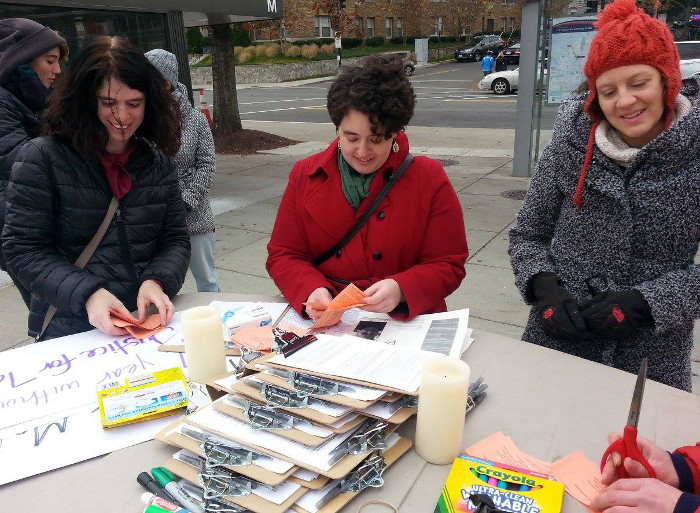
SURJ – DC Chapter, 2015
Part Three: Freeing Ourselves from the Prison of Separation
I want to spend the rest of the time with the inquiry, “Okay, so what heals us? What helps to awaken us to that space of beloved community?” Because I’ve been watching how the dharma, the teaching, the ways of paying attention, will do it. They will do it. The more we pay attention, the more we’re gonna really want to feel what iss creating separation, and we’ll start examining it, but it needs to, at some point, become very intentional. So we’re examining it because we really want to learn and understand. Because we really want to get the landscape of what actually has happened in this country and what’s actually shaping our own identity. “What is it that I’m not seeing?” That’s been my biggest question. What is it that I’m not seeing?
At a personal level, up until about 8 or 9 years ago, if you had asked me, I would have said that I was pretty conscious about race. And I would have assumed that the Buddhist sanghas were welcoming to everyone. My father was an attorney who did a lot of civil rights law, and he had a very racially mixed group of friends, which was very unusual at that time, but that’s just the way I grew up. When I was in grammar school, I was one out of five white kids in an all African American school, so I had an unusual experience there as well. I’ve also lived a number of seasons of my life being an outsider, including wearing garb for ten years, where anyone who looked at me saw me as different. So because of those things, I just assumed that I was somewhat awake to this stuff, but I got the rug pulled out from under me, and it happened because of certain friendships that got really deep with a handful of people of color in the D.C. Area. These friends started letting me know what life was life beyond my bubble. Really letting me know.
One of them was one friend in a diversity focused sangha, an African American women, who described driving around with her father when she was growing up. Periodically, he’d be pulled over by the police for nothing, just because he was a black man, because that’s what happened. And she described how painful it was to see the humiliation he experienced at her watching it happen. It hit me what that was like, to have his dignity was taken away, he felt, in her eyes, and the profound impact of that. If that had happened to my father, if I had watched him be humiliated like this, it would shaken my world as a young person.
Another experience like this happened in this room, where a friend of mine from the same diversity community came to the class here. I was talking about raising our children, mirroring their goodness and giving them a sense of confidence in themselves, the unlimited capacity that they have to really make it and be all they can be in the world. My friend raised her hand and said, “I’ll tell you, I want to give my son fear. I want him to be afraid, because I am scared to death, every time he leaves the house, that he’s going to get either arrested or killed.” And she had a right to be afraid. She didn’t want her son being cocky or oblivious to the risks he faced as a young, African American male – she’d rather him be scared and alive. Again, this started making a dent in my white “space suit.” I basically assumed that doors would open for my son. That he’d go into the world and have opportunities and if he trusted who he was, he could take advantage of those opportunities. That was just an assumption. And I realized tat that assumption was white privilege.
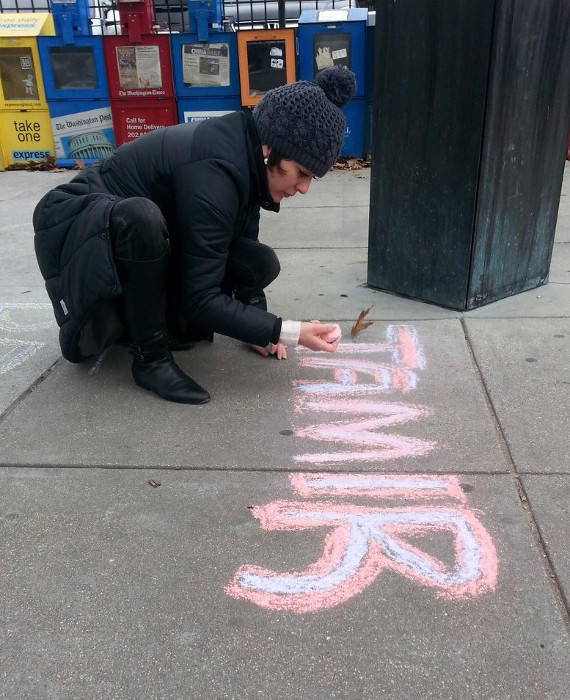
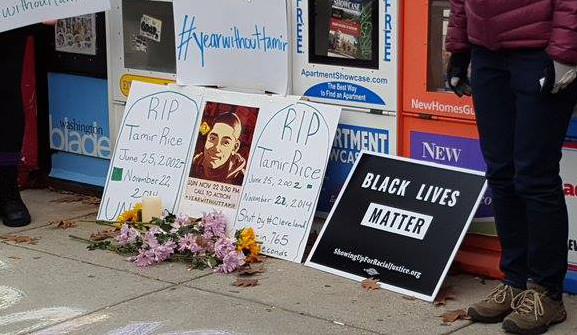
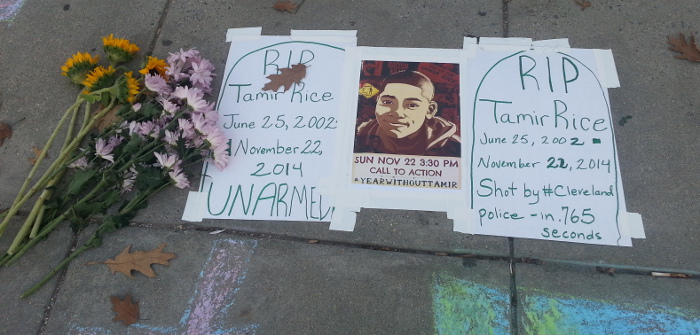
When we don’t pay attention, others are still unreal others. We have to get close in to feel that the trouble “others” are having isn’t “out there” in the world, separate from me. It is “in here”, and it wants my attention. Shortly after Ferguson, I went into Washington where there was a vigil of grieving mothers. Did anyone here go to that? This was a group of about 15 grieving mothers. These were women whose sons had been killed by the police. They were from all over the country, and they got together and traveled around, telling their stories. One of them told us how her son got shot the day before her birthday. He had been planning her party. Another described that after her son was shot, he said to the police, “I wasn’t doing anything wrong. Why did you shoot me?” One woman’s son was about to get married, and another was shot yards from a hospital but the police refused to take him to an emergency room. These mothers were telling stories that broke my heart and would break the heart of anybody here who would get close enough to listen. And we have to let our hearts be broken, or else we’re gonna stay in a very insulated identity, because as a white person you can live for decades and not get exposed to this reality; not care enough to be part of the healing. We have to pay attention.
The truth is, I’m actually hopeful. Part of me wants to cry, and part of me wants to say to you I’m hopeful right now. I’m hopeful about beloved community. For those who are listening and who are from this country, the United States, there’s a very particular history we have. The legacy of slavery and genocide is very particular, and the ways in which white people occupy a place of privilege and dominance, which we’re blind to, is also very particular. It takes effort to get to know what happened and to get to know our part in it. It’s not about making anybody wrong. In fact, one of the things I find inspiring about the very beautiful movements that have been emerging, especially among the front-line communities who make up Black Lives Matter, is that one of the main teachings is love. For the folks fighting against oppression, self love is a central force, and that’s true for all of us. We’ve gotta love ourselves and each other through this. It’s really true, that if white people are gonna have the courage and honesty to look at where we’re blind, or holding onto dominance and not even knowing it, or enjoying our privilege, we have to be incredibly forgiving because it’s not a personal. We are not personally bad. It’s just collective conditioning. It’s not our faults, and yet we can be responsible. We can respond.
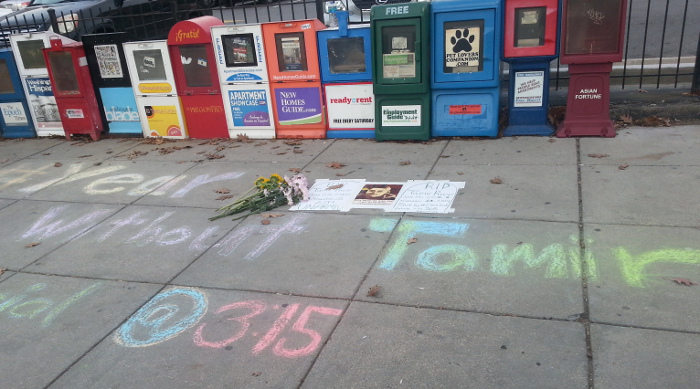
So we have to learn about the particulars, the realness of what’s emerged, and we need to engage with others. In Washington D.C. we have affinity communities, including groups for people of color where it’s safe enough to really begin to process the effects of racism. We have white affinity groups as well – right now I am part of a year long white awareness group. We need to be in situations that are safe enough to speak what’s true and examine the identities that have collected, and we need to be with each other in mixed racial situations as we get a little more mature and able to speak from wisdom. We need to be able to name where the hurts are; be able to name our sorrows and fears; not to be afraid of anger. So often in Buddhist communities, anger is described as bad and there’s not room for anger, when anger is part of the weather systems that are moving through. We have gotta make room for these emotions, and there are wise ways to do that.
So we’ve got to be with each other, engaged with each other. White people need to be in solidarity, in helpfulness, aligning ourselves with those who have been suffering from white dominance. We need to get on their team. Not in order to help out “the other,” but because it frees us; it frees us all.
Last month I was part of a teaching team for a historic retreat in the Buddhist community, because we had a very mixed race teaching team and body of participants. On opening night, when I looked out on the group of people that had gathered and 45% of the people in the group were people of color, I started to cry. The realness of it. Because everything in me went, “This is the community I want to belong to!” This richness of being together, not being in little bubbles. To be in our togetherness with a shared intention to wake up.
Earlier I shared from Einstein, who writes about this optical illusion of consciousness that keeps us separate, and he ends that quote by saying: “Our task must be to free ourselves from the prison by widening our circle of compassion to embrace all living creatures in the whole of nature in it’s beauty.” Beloved community. Let’s practice together, and take a few moments to give ourselves that gift of deepening attention.
Photo: Digital Archaeology
Part Four: Closing Meditation
From the starting place of deepening attention, notice what is going on inside you right now. See if it’s possible to recognize whatever you’re feeling right now, and allow it to be as it is. Just allow it to be as it is.
If we want to wake up from limiting identities that separate us, we have two tools. One is to notice what’s happening: notice what’s happening in our own bodies and minds, notice what’s happening in the collective. And the other tool is to regard that with deep compassion – no blame, just compassion.
So we begin right now in our own individual body and heart: What is happening? What’s the feeling tone in the body, and the heart? If you’d like you can put your hand on your heart and just offer a very kind presence with however it is. If in listening tonight you’ve had reactivity of any sort – feelings of anger or hurt, confusion or overwhelm, aversion … just agree to let those weather systems move through. It’s okay. It’s part of it.
We’ve been talking about collective identity … You might now widen your attention to sense whatever your identity of race is – as a person of color, or as a white person – just notice what the attitude, beliefs, or assumptions might be. Just notice and hold with kindness – if you have felt oppressed. If you have felt treated unjustly. Let that be there, as part of this collective identity. And if you’ve been in the dominant culture, just notice, what is the “space suit” identity that comes with that? Holding with honesty and curiosity and kindness.
You might notice if there have been assumptions of superiority or inferiority, in terms of skin color. Just have the inquiry here.
You might bring to mind one particular situation with a person of difference from you where you feel separation, and where you are aware of it. Just look honestly at whatever assumptions or biases are at work. Maybe you feel the bias that you are inferior, or you are looked down upon, you are pushed out. Or it may be one, in some way, of feeling superior, in charge. Just take one example in your life, of your experience with a person of difference. Again, let yourself be aware – with honesty – seeing if it can be not so personal, more just sensing, “Okay, so this is a space-suit identity, a collective identity, that has this kind of built in conditioning.”
Honest, and accepting.
I wonder if you can look at that person, that person of difference who seems unreal, see the possibility of looking more deeply at who that person really is, whoever you have in mind, whether that person is one who is dominant, who is oppressing, or whether that person is someone you are feeling superior to. Just look more closely. See if you can see into that person’s humanity and goodness.
These closing words come from Nelson Mandela. He writes:
“No one is born hating another person because of the color of their skin, or their background, or their religion. People must learn to hate, and if they can learn to hate, they can be taught to love, for love comes more naturally to the human heart than its opposite. Even in the grimmest times in prison, when our comrades and I were pushed to our limits, I would see a glimmer of humanity in one of the guards, perhaps just for a second, but it was enough to reassure me and keep me going. Human goodness is a flame that can be hidden, but never extinguished.”
As we close may we feel that longing of our hearts for beloved community, and may we feel our potential to wake up from that which separates and to hold hands with the depth of love, and the depth of respect, in which we find our freedom together.
Namaste, and thank you for your attention.
Tara Brach, Ph.D., is is nationally known for her skill in weaving western psychological wisdom with a range of meditative practices. She has practiced and taught meditation for over 35 years, with an emphasis on Vipassana, or Insight, meditation. Tara is the senior teacher and founder of the Insight Meditation Community of Washington.
If you would like to listen to the full audio recording of Tara’s “Beloved Community” talk, you can do so here.
click here to return to Community Voices table of contents
 White Awake