“Stories are compasses and architecture; we navigate by them, we build our sanctuaries and our prisons out of them, and to be without a story is to be lost in the vastness of a world that spreads in all directions like arctic tundra or sea ice.”
This writing excerpt is based on a presentation offered by rain crowe at the Cascadia Rising Bioregional Confluence, held in Portland, OR in 2014. The exploration of the intersection of white settler-ism and bioregionalism is intended to speak to those of us who identify as non-native to the North American lands, and who are of European descent. The invitation is to begin an exploration of the genocidal roots and ongoing impacts of our white settler presence on Turtle Island, while also holding a connection to our own indigenous ancestors and their subsequent colonization.
For those of you who are not familiar with pagan practices, the piece is written in a Wiccan ritual form (with roots in pre-Christian traditions of the British Isles). You are invited to read this piece as a poetic essay, or enter into the offering as a practice. The form of this practice is available for you to use, respectfully and with acknowledgment of the source, in other contexts as well.
The basic framework of the ritual form: prepare yourself and the area through centering, calming, and/or focusing practices (“Grounding”); create sacred space (“Casting”); invite spiritual powers to guide you (“Invocation”); and do the work you are there to do. Though not explicitly outlined in this written excerpt, it is best to “open” the circle that has been cast by thanking the spirits that responded to the invocation, and releasing the energy that was built, while affirming the intention of the work. As a reference point for Buddhists, a similar concluding practice is the dedication of merits.
You might want to engage in this inquiry alongside the interview with David Dean, whose experiences with residents of the Crow Indian Reservation prompted him to ask questions about his European ancestry, the forces that led to a culture of violent conquest, and the possibility of healing and reconnection to more life-giving ancestral ways. This excerpt has been modified for White Awake. You can read the original version of rain crowe’s piece in the Zine “Cultural Appropriation and Spirituality”, housed online at Witches Union Hall here.
Grounding
Into a deep sense of place, the exact place where we are, we send down our roots.
How did the terrain come to be the way it is in the process of deep geological time? How did the elements shape it? How did the waters flow upon it? How do they flow now?
What creatures of the world have lived here, are no longer, or still remain?
Who were and are the first peoples here, and where are their descendants now?
How did we come to be where we are, and what does our presence mean?
Casting
The sphere of life is omnipresent and we cast ourselves into its embrace with a remembering of wholeness that dispels the ensorcellment* of Estrangement, Entitlement, and Enslavement, those markers of a pathology that is insidious, addictive, and life-diminishing.
(*ensorcell: to bewitch)
Invocation
Photo: rain crowe
Ancestors of path, land, blood, and love, for those of you who are called to be with us, we invite you to join the feast we set for you, the feast of praise for your willingness, the feast of grief for your sufferings, the feast of longing and delight for all your gifts…
To the Descendants of Life, we invite you to our magical workings that we might leave a living world for you to embody as creatures dancing the preciousness of the good Earth, our only home…
And to the Stars of Possibility, and the Underworld of Mycelial Wovenness, and to all our guides and allies,
Welcome.
Feeling for a path of right relationship: an inquiry and spiritual working
If our words are spells, and the language we use creates the consensus reality in which we live, then let us choose carefully, intentionally, and wisely how we language ourselves into the consciousness of a journey of healing, of decolonizing, and of calling ourselves home.
This is a slice of a template used to work with the difficult and necessary conversations of cultural appropriation, presence to the privileges of white settler colonialism, and healing of inter-generational and cross cultural trauma brought about by the global wounds of Empire consciousness. Since some of our oldest stories live in the language we use, we begin with the words “inquiry”and “complexity”.
Inquiry
Inquiry is any process that has the aim of augmenting knowledge, resolving doubt, or solving a problem. It is a question, a query, and a close examination of a matter to find truth. The etymology is Old French borrowed from vulgar Latin and the root means: to seek.
Moving from inquiry can be a redemptive act in that it helps us craft the map of enduring questions, those which have no easy answer, to which we can only aspire to lend to some small piece of knowing in our time, and from which we might preserve the layers and registers of our collective glimmers of understanding.
Complexity
Complexity is generally used to characterize something with many parts where those parts interact with each other in multiple ways. The word comes from French borrowed from Latin and the root means: to braid or twine that which is intricate.
Complexity, within the inquiry at hand, means understanding that we [“white people”] come from many different places, and that for thousands of years our European ancestors lived indigenously in cradle to grave cultures of right relationship to place and life. This is one lineage.
There are many stories about how and why the shift away from right relationship happened; suffice it to say another one of our lineages is that of colonized linguistic cultures of Empire defined by a consciousness that shifted to definitive oriented understandings rather than relational-mystical understandings. These linguistic cultural ancestors are the ones who were displaced, assimilated and colonized themselves, and who would come to perpetuate an “orphan trauma” of disconnection to place. They live within us as well.
“King Philips War”
Having a foot in two worlds of ancestry, how do we proceed? Can we be a hinge in time, inviting spiritual home into our lives with the vestiges of amnesia still tangled in our hair?
What is right relationship? An incomplete answer, to put something on the table for each of you to contemplate and explore, is: Being right sized with our power, our presence and absence, our consumption, and our impact. We feel for it because we are making the path as we go along, using all of our senses to ask the questions, take the actions, grow our tolerance to the distress of not having the answers, and our resilience to the discomfort of not knowing.
For those of us thoroughly indoctrinated in the culture of shame and punishment, it can be terrifying to endeavor into the very necessary conversations about our tendencies to fill the holes of our own longing, and unrequited needs for spiritual wholeness, in ways that may be perpetuating the harms of our colonized and colonizing ancestors.
Un-shaming our mistakes, while not letting ourselves off the hook of response-ability, is imperative to feeling out the path. Acknowledging that our shadow – the sum total of all the parts of ourselves that we repress, neglect, deny and disavow – is always in the room, and is always in the conversation, can make it easier for us to access empathy for ourselves and our communities of conversation and connection. Our shadows are the edge places of discomfort, learning, and enrichment. Learn to notice them and to befriend them.
Template questions
You are invited to read these aloud and to notice the sensations within your body.
What is home?
What is culture?
How do we begin to unravel what it means to be a person of European descent in this time, who comes from both far off indigenous and, most recently, colonizer ancestral lines?
How can we make sense of, and possibly respond to, the inter-generational and cross cultural trauma within Empire culture?
What did relationship-to-place mean to our ancestors? What could it mean for us?
Who were and are the first peoples of the land where we now live, and what does their presence or absence mean?
How did we come to be where we are, and what does our presence mean?
You are invited to resist the impulse to answer the questions. Instead allow more questions to fluidly move through you. Where does the pathway of questioning take you? What other doors open, what other insights arise, what is your body telling you?
Re-member. Sitting with the complexity of your inquiry, guided by your intuition, and holding a steadfast gentleness alongside a commitment to persevere, make symbols of your questions, or work with your hands as you ruminate, contemplate, and meditate. Let your body sense the next steps; maybe you will reach out, find a book that calls to you, make art to express, or ask for guidance in dreams about what is coming through. Continue to resist the impulse to “know”, and instead make offerings to feed the Sacred with gratitude as you stretch your capacity to be in the wonder of midwifing a beyond-our-lifetime vision of right relationship to the web of life.
Blessings.
**
rain crowe works with and from a body of work dedicated to cultivating the arts of interdependent relationships through group facilitation, mediation, and educational opportunities. She is a regenerative culture events organizer who engages with spiritual, political, rewilding, and intentional communities. She teaches and writes about magic and ritual, the ancestral skills of council making and restorative conflict transformation, systems thinking in radical organizing, and ecstatic connection to the sacred.
rain is grateful to all of the teachers with whom she has studied: Dominic Barter, Martin Prechtel, Starhawk, Arnie Mindell, Cynthia Jones, Suzanne Sterling, and Geri Ravyn Stanfield, and to all of those teachers who have influenced her from afar: Bill Plotkin, Joanna Macy, Brian Swimme, Thomas Berry, and Pema Chodron. Special thank yous to all the peer teachers in life who keep her on her toes.
New Curriculum, SURJ-Faith Pilot Learning Project, HBC “Buddhism and Race” conference, and more!
Photo of presenters from the Second Annual “Buddhism and Race” Conference; courtesy Harvard Buddhist Community
Harvard Buddhist Community: “Buddhism and Race Conference”
The second annual Buddhism and Race Conference (organized by the Harvard Buddhist Community at Harvard Divinity School) took place this past April, and brought together a beautiful community of activists, sangha leaders, community members, and students to learn from one another and share justice-oriented teachings and training. You can watch each of the three panel discussions on Youtube:
White Awake director Eleanor Hancock spoke on the third panel, and offered a break out group entitled “White Affinity Work Demystified” for conference participants. Attendance was overwhelming! The hunger for support and strong white affinity materials really emphasized the importance of a project like White Awake.
SURJ-Faith National News
Showing up for Racial Justice’s inter-faith network is on the move, and we hope you will join them. This past weekend, faith communities around the nation participated in a “Love is Unstoppable” action to assert faith-based values of love and inclusion in the face of Donald Trump’s retoric of hatred.
At the same time, the SURJ-Faith team has developed a Pilot Learning Project to support congregations/spiritual communities in responding to the call for white people of faith to be more bold in taking action for racial justice. We hope you will considering bringing this learning project into your spiritual community. SURJ-Faith will be having two national Q&A calls to about the project. You can register for a call here.
White Awake offers support to SURJ-Faith through Eleanor’s membership on the national team.
In keeping with our mission to grow the curriculum offerings that are presented on our site, and to be a place where diverse communities of practitioners and leadership can “see” what one another are doing, White Awake has just added two new pieces of curriculum onto the site! The SURJ DC 7 Month Study Curriculum offers readings and discussion questions designed to building a shared understanding among participants of what racism is and how it dehumanizes all of us. “Am I Doing Enough” is a short series of activities that incorporates reflective inquiry, meditation, and visual art into a one hour sequence designed to explore the question: “How can I tell the difference between anxiety born of white guilt, and true messages coming from inner wisdom that I am not adequately engaged?”
Radical Dharma: Talking Race, Love, and Liberation
White Awake is encouraging our community members, Buddhists in particular, to pre-order your copy of “Radical Dharma” now! In this new book Rev. angel Kyodo williams Sensei, Lama Rod Owens, and Dr. Jasmine Syedullah outline the ways that racism and privilege prevent our collective awakening. Release parties will take place all over the country, including Brooklyn, Berkeley, and Boston. To stay connected join the email list on the site.
Building White Awake through Fundraising
As you know, White Awake is a collaborative project that relies on contributions such as yours to maintain and expand our offerings. This year, we have very exciting news – a large donor has pledged funding that is building a foundation for White Awake’s future! While some of this funding has been released, in order to secure all of what is promised we need to demonstrate substantial progress towards our annual fundraising goals through other sources. That means that you can help us meet our funding goals, and secure the donation! We hope you will consider doing so by making a tax-deductible contribution online here.
Chris Crass holds a strong voice in activist community and inter-faith communities both here and in Canada. adrienne maree brown (Co-editor, Octavia’s Brood), gives a wonderful introduction to Chris’s work in her endorsement of his latest book:
“White supremacy is an overwhelming crisis for humanity, one that is making it impossible for any human to evolve in right relationship with the planet and the species. It has not, and will not, be resolved merely by Black and other non-white people fighting for a change – it must be unlearned, relinquished by those who walk with the privileges of whiteness. Chris Crass has been stepping up into leadership in this work in ways that reach beyond ally, all the way to comrade. I know he does the work not to be politically correct, or down with people of color, but because his soul demands it.”
This article is a lightly modified transcription of a talk Chris gave at the Washington Ethical Society last fall. The full audio is embedded below.
It’s beautiful to be here with the Ethical Society. It’s beautiful to be with a congregation on the move for justice. We live in Black Lives Matter times. We live in times where people are taking to the streets, people who’ve been told “your voice, your lives do not matter. Your voices, your leadership is insignificant.” Working class black communities in Ferguson, Baltimore, and all around the country are saying: “We will not bow to supremacy systems. We will not have our lives taken without resistance.” The racist violence we’re seeing in the news is not new. It’s the resistance and people taking the streets and people saying “No more!” that has caused the headlines all over the country to be filled with the news of the latest racist violence, or the news of right wing reaction to Black Lives Matter. You’re seeing this? You’re feeling it? I know you are because you’re a congregation that’s involved.
Black Lives Matter times means that structural inequality, things that have always been right there below the surface, are being brought to the fore for the whole country to have to engage with, to have to see. Choices have to be made about what side of history we stand on. Many of us look back at different points in history when movements have been on the move and say, “I would’ve been on the right side. I would’ve been an abolitionist. I would’ve been a sit in activist”, and many of you were involved in the 60’s and 70’s. But it’s often easier to look back and assume that we would’ve been on the right side of history than to be on the right side of history when it’s happening now and it’s complicated.
We live in times where being on the right side of history requires courage and communities of courage. That’s why it’s beautiful to be with a community engaged in creating action for Black Lives Matter. And it’s an ongoing commitment, an ongoing struggle, to stay involved. When I think about my own experience, as a white young person being raised in this society, when it came to race the most vocal white voices were the racists. The white people that could talk the most passionately, articulately, and consistently, with no fear, were the racists in my family and in my community. The white people who wanted to be on the right side of history were often terrified to talk about race, afraid to say the wrong thing, awkward and confused, but good-hearted white people. You with me?
It’s understandable, because white supremacy is an unconscious agenda moving forward. So if you’re a white person that says, “I’m just trying to do my thing, race isn’t my issue” you are on the conveyor belt, fully supporting the white supremacist agenda. You’re either actively saying “I choose to engage in anti-racist work in my society and my community”, or society will perfectly fit you into reproducing white supremacy every day. You with me?
How many of you woke up today and said, “You know what, I really want to reproduce white supremacist capitalist patriarchy today; I want to make sure those systems are fully functional.” How many of you woke saying, “It’s another day to further oppression!” – ? We don’t. We wake up and we want to be justice loving people. But it’s not just about good-hearted people; it’s about institutions and culture and policies and laws and the way the economy is built.
Anti-black racism is not an attitude. It is the foundation of the economy of this country. It’s the foundation of the political system of this country. Confronting anti-black racism is at the heart of the Black Lives Matter movement, challenging it, calling out how deeply embedded it is in the foundation of the United States. You with me? Calling this out requires courage. Because white people and folks of color internalize racism, internalize the logic of the system, and to stay in this movement we have to fight against it; all of us have to fight against the logic of racism and white supremacy that impacts our lives and our communities.
When you step off that conveyor belt that’s moving you towards furthering white supremacy, it’s a little shaky – you’re legs are wobbly; you’re unsure of the ground you’re standing on. It can be awkward and confusing and the next thing you know everything you do seems to be a mistake. Am I right? It requires courage.
Photo: Kirk Mckoy / Los Angeles Times
Part Two: Los Angeles Burning
I remember for myself as a young person, I really came of consciousness in the early nineties with the Rodney King verdict. Those of you who were around then remember the Rodney King verdict. It was 1992; an African-American motorist who was speeding got pulled over, late at night, and was brutally beaten by four white police officers while a much larger ring of officers stood around keeping a perimeter. It was videotaped; the video went viral.
As a young person I thought, well of course, justice will be served. Even as an activist (I was politicized early) I thought, “The officers got caught on tape; they will be charged.” I was 18 years old. The trial was moved to a courthouse thirty minutes from where I lived, to the white middle class suburb of Simi Valley. The results: acquittal; no charges against the officers. You know what happened next – you can feel the echoes with each grand jury today. I could feel it all around me as Trayvon Martin got put on trial for his own murder, and George Zimmerman was acquitted. Over and over and over again. Thirty minutes in the other direction from my house, the multi-racial, working class city of Los Angeles erupted.
Before Rodney King, the narrative around race that I grew up in, as a member of a liberal white family, was, “Hey, the civil rights movement happened; Dr. King gave a speech; now we’re post racial. We’re colorblind.” You hear that all the time, right? “We’re colorblind.” Now Los Angeles is erupting, and the flames are burning down my whole worldview. I had no idea that I even had a worldview to begin with, but after this I knew. I could smell it burning.
Photo: Kirk Mckoy / Los Angeles Times
I had no idea what to do next. About 15 of gathered together the night of verdict and we were angry. I mean we were united against racism, which is a good place to start. That’s some good unity to build with. But we also had the belief that racism came from individual extremists. There was one black person in our crew of mostly white social justice activists: Terrance. Terrance didn’t often talk about race, and I just assumed that was because we’re colorblind, we’re post racial. We talked about class, we talked about economic justice, but we didn’t talk about race. That evening, though, Terrance started talking about his experiences of racism. He said, “We’re friends, but in order for me to be here with you on this night – as Los Angeles is in flames, as people all over the country are rising up against this verdict – I need to talk with you about my experiences with racism.”
It was a powerful moment, because oftentimes—and many of you are painfully aware of this—when a black person starts talking to white people, rarely do white people let that black person finish a sentence, unless that black person is telling those white people how great they are. But if a black person starts talking about their experiences of racism, the but-but-but-but-but river of denial flows. You with me?
That night, however, something powerful happened because Los Angeles was in flames, and a whole group of white people just listened while Terrance started talking about his experiences. One story he shared was about being the class valedictorian on the way to his high school to give his speech. This school was mostly white, mostly middle class; he was one of the few black students there. He was in front of his high school, excited and going over his speech in his head when the police stop him. The white officers start searching him. He doesn’t have his student ID on him, and they don’t believe that he goes to the school there. They laugh at him when he says he’s the valedictorian. They say, “You’re here to break into the cars of the parents while they watch their kids graduate.”
The white students and their families are walking by, awkwardly; they see him but just keep going. Terrance says that even though none of white parents said it, he could feel this look on some of their faces. It was like, “Good job officers you got him. That kid’s probably trying to sell drugs to my child.”
Eventually someone finally stopped and said, “He goes to this school, he is the valedictorian.” Terrance gave his speech, but he was in a much different place than he had thought he would be while giving it. He said that that incident reminded him that, “Yes, you’re the valedictorian, but don’t forget your place. Don’t forget who you are. This is not your school. This is something that was given to you. It can be taken away at any moment.”
It was painful, and it was devastating. And for those of us who were raised white, hearing about race for the first time, if you let your heart listen to it, it can be devastating for us to. For those of you that are folks of color, to talk about race and to have a white person finally just listen, I think you have an idea of what that night in Los Angeles might have been like. These are moments where transformational consciousness can happen, where ethical values can be developed. But nonetheless, I felt horrible, I felt guilt, I felt shame. Anyone here ever felt that? Whether you’re a man and you find out you’re sexist and you’re like “oh my gosh!” Or you’re a white person and you realize you’ve got internalized racism. You feel terrible. The history is brutal.
After this I started going over to my friend Terrance’s house and he had a poster up on his wall of all these black leaders. Looking at that poster, I realized I didn’t know who any of them were except Dr. King – and even Dr. King I’d essentially been taught about by the right wing, who just said, “Dr. King had a vision about no one seeing color and no one talking about race again”, which of course wasn’t Dr. King’s message at all.
So, I’m over at Terrance’s house and I look at all these black leaders and I asked him, “Who are these folks?” And Terrance started to explain:, “This Ida B. Wells, who spearheaded the anti-lynching campaign of the early 1900s. This is Septima Clark, and she was the architect of the citizenship schools in the sixties that taught tens of thousands of young, black folks throughout the south not only about citizenship rights like voting, but about how being active participants in a democratic society can transformation the relationship to power so we can all be free and equal.” He was breaking it down! And I realized, I was 18, with three years already as a social justice activist, and this was the first time in my life I was hearing a person of color explain history and politics.
I had no real way to make sense of what he was saying. It was almost as if someone was speaking another language. Week after week, I’d be like, “Terrance, who are these people again?” And finally he said, “Look, I’m not telling you about these people because you feel guilty about Rodney King, and you just want to know a few things about black people.” You know what I’m saying? This isn’t, “now you have a couple things to pull out of your pocket if a conversation about race comes up” – just so you can say, “Yea, Ida B. Wells, I know about her.” Or during black history month, so you won’t feel so bad. Terrance said, “I’m not telling you who these people are to make you feel better. And I’m also not telling you who these people are because they are my leaders. I’m telling you about WEB Du Bois and Ella Baker because they are your leaders too.”
Then Terrance said something that changed my life. He said, “One of the ways that white supremacy hurts white people is that it makes them functionally illiterate to understand the world around them and it teaches them that they have nothing to learn from the histories, legacies, culture, literature, poetry, lives, experiences of people of color historically and today. White supremacy is gutting the foundational democratic people’s movements of this country from your consciousness. White supremacy is turning you into a well-intentioned, good-hearted, wants-to-do-the-right-thing person, but is only showing you the steps to take to further oppression.” You with me? I said, “Oh my god.” It changed my life. And I feel the echoes of those moments, of those conversations, each time one of these grand jury announcements comes out, each time a new rising up for black lives matter happens today.
As I started getting this new consciousness, I got involved a multi-racial coalition at my working class community college. At first we were working around fee hikes, working around economic justice, but not talking about race. We had people of color leadership, MEChA and the Black Student Union. And we were powerful. We were mobilizing hundreds of people at this commuter college in Orange County California, the hot bed of right wing politics, the Ronald Reagan coalition—the base of right wing politics.
We had a multi-racial student coalition working around fee hikes, and we had mass support, hundreds of people coming out to our rallies. But then one of my mentors, a leader of the coalition—David Rojas—said, “Next semester we’re going to fight not only for free education but for education that represents who we are as people. We want expanded ethnic studies, more black studies, more chicano and chicana studies, more women’s history. And we also want more faculty of color—women of color faculty in particular—hired.” I was like, “Let’s do it!” I had no idea what was about to happen.
Our mighty coalition studied Howard Zinn’s People’s History of the United States together to prepare. The next semester begins. We start having rallies, demonstrations, putting out leaflets about ethnic studies, women’s studies, hiring more faculty, a democratic education for all …
Me and a lot of my white friends were taking ethnic studies classes, and we were still involved. But almost all of the white support vanished. And even some of the progressive white professors who had been encouraging us were like, “Why are you taking on the race issue? That’s going to divide everybody.”
We had a rally for ethnic studies. Shortly after, the coalition that had been heralded in the local newspapers as a revival of civic engagement was now the coalition that divides the campus. MEChA – who had been a leader of this coalition, who had been referred to over and over and over again as the campus heroes for building up this coalition and re-engaging students – was now being called an anti-white hate group.
Apparently, if you talk about ethnic studies, if you talk about hiring faculty of color, if you start talking about racism, that means you’re anti-white. And the same thing’s happening now: Black Lives Matter is a terrorist organization that hates white people. Right? Audience: “No!” See, that’s why I come to the Ethical Society.
At the same time that these rallies started happening for ethnic studies, ads started appearing in newspapers all over California saying that the reason student fees were going up is that illegal aliens were taking over the state. It was the beginning of a massive, anti-immigrant attack in California in the nineties. This was also being put forward at the same time that we were talking about ethnic studies – so we started talking about immigrant rights.
Right at that time, we hold a rally, and I’m walking towards it, and at first I was like, “Wow there’s a lot of white people here! Great!” But as I get closer, I realize what’s happening.
There are a couple hundred white people surrounding a much smaller demonstration of mostly Latino/Latina students with some of the Black Student Union members as well—all people of color, black and brown. And they’re surrounded by about 200 white students who are yelling, “Go home! Go Home! Go back to your country! Go back to your country!”
I would bet that every single one of those white students, if they were asked, would say that they weren’t racists. Because we live in a time of colorblind white supremacy, where there are no racists anymore. I mean the Klan will talk about how they’re trying to support white people’s continued existence, and then they’ll say, “yea, yea, we are racists, we’re the Klan.” But over and over and over again we hear, “No one’s a racist.” Even when they perpetuate racist things. They say, “It’s a misunderstanding, you don’t understand my joke, my humor.” You know what I mean?
So as I approach this rally, there’s this huge crowd of white folks yelling at my friends and the people who are part of the coalition—all people of color. And I’m standing on the outside and I can see them in there.
How many of you have been in many situations where you’re standing in a position where you know the right thing to do is over there, and something terrifying is in the way? Something terrifying is in between you and the right thing to do? You with me? The Black Lives Matter movement is over there, but a Fox News right-wing media machine has created a mob of folks yelling and screaming at the Black Lives Matter movement.
That’s the situation I was in. I needed to get there, but I needed to go through something terrifying to get there. The thing to do, in moments like these, is to think about what brings you courage. For me, as I start making my way through all these white folks, I start thinking about ancestors. I start thinking about the ancestors on Terrance’s poster. About social justice ancestors who I deeply respect, and I make it through the mob of white people, I join the protest, and I pick up a sign for ethnic studies. When I do this, the white students just kind of lose it. They start yelling, “Race traitor! Race traitor!”
This was particularly surreal, because at the time I was in fact reading a journal called Race Traitor. I had been reading in this journal about how white supremacy keeps people from coming together to create a humane society that benefits all people; about how the development of white people in the first place happened by convincing European working class and poor people they were “white people” who were best off aligned across class to a ruling class agenda which does benefit them but perpetuates this idea that it’s a white society. So even if you’re a working class white who doesn’t have good healthcare, who has a crappy house, whose kids are going to a school that’s falling apart, you can blame every person of color around you for those problems and simultaneously feel like, “At least I’m better than them. I’m white.” You with me?
W.E.B. Du Bois, one of the people Terrance taught me about, he said that white people exchange economic justice, exchange an ethical society based on the values that are truly at the heart of who we are in this room, exchange those commitments for the psychological and public wages of whiteness. And it’s happened for generation after generation until white folks don’t know that this is what is happening, or that we have a choice. It’s just the way things are.
The Black Lives Matter movement is a time of exploding consciousness, realizing that there are choices that have to be made – and that’s the kind of experience I was having in the 90’s, participating in this multi-racial coalition, mobilizing for ethnic studies. And I’m there with my friends, the only white person who is part of the protest, and all the whites around me are yelling:. “Race traitor! Race Traitor!”
Then this one guy gets right in front of my face and asks, “What color is your skin?! What color is your skin?!?” And I realize – I’m being called back.
White folks are telling me, “You’ve stepped out of line, and I’m calling you back—you’re supposed to be on this side of the line.”
This is how it is now, right? We act like racism doesn’t exist anymore but then you start talking about racism and the vile, racist poison just comes shooting from all directions. Am I right? “Everything’s fine. Don’t talk about race. We don’t have a race problem here. Maybe somewhere else, but not here.” And then Black Lives Matter starts taking to the streets, and the poison and the evil starts coming out.
How many of you here have studied the great struggle of Harry Potter? If you have, then you’ll be familiar with the Voldemort principle of supremacy systems. Voldemort is a right-wing fascist leading an army to impose pure blood supremacy within the wizarding world. Biological differences that, in a diverse society, would only be seen as beautiful representations of our full humanity, in a supremacy system become ways of organizing people into hierchies. You with me?
Of course Voldemort wants to crush critical consciousness at Hogwart’s and get rid of the gay professor Dumbledore. But we also know—and I won’t give too much away for those of you who haven’t finished the series—that Voldemort is not only “out there”. Voldemort gets “in here”. White supremacy is “out there”, patriarchy is “out there”, and it’s also “in here” – it’s the same.
For those of us raised into white privilege, into a white ignorance of racism—white silence, the centuries-old code of white people. White silence in the face of racial injustice. Not only silence but the inability to see what’s right in front of you – this is the way white supremacy gets “in here”. You with me? So Voldemort’s “in here” too.
But thankfully, just like in Harry Potter, we have people like Hermione Granger and Ron Weasley—folks who fight back against Voldemort. Hermione Granger is like the Ella Baker of the wizarding world. She organizes. There’s important lessons about Hermione because she made some mistakes with the whole house elves situation, but she learns from it. And those of us who are white, and those of us who are male, we start coming into consciousness about feminism and about racism, and next thing you know we’re off the conveyor belt and we’re not sure what to do, and we start to get really awkward and really scared about where to step. Am I right?
For a lot of white folks the number one concern is not to say the wrong thing. Folks of color are like, “My number one concern is the annihilation of my community.” But I understand, as a white person you come into consciousness and you don’t want to say the wrong thing. But again, it’s not about individual behavior, it’s about institutions and structures. So Hermione learns from her mistakes and she helps form Dumbledore’s Army. We need a Dumbledore’s Army that brings all kinds of different people together to fight for collective liberation.
So, bear with me here. With Harry Potter, there’s the Horcrux strategy of collective liberation. Horcuxes are how supremacy systems live in the institutions—healthcare, education, housing. It’s in the policy, not the decisions of one particular racist neighbor. I’m talking about policy decisions to create all-white, low-interest loan suburbs and redlining communities of color. Policies that impact millions of people’s lives. So the Horcrux strategy of collective liberation is for all of us impacted by supremacy systems (which is all of us!). We have to simultaneously work against the structural inequality in society, while getting the death culture of supremacy systems out of our minds.
But I will also say that sometimes when you start to become conscious of supremacy systems, the impulse can be like mine when I found out about racism and sexism. When I realized how I’d internalized patriarchy and racism as a white male in our society, my initial feeling was, “Oh my god, I’m a sexist, too! I’m a racist, too! Maybe the best thing I can do is stay in bed. I won’t say something messed up to somebody, I’ll just stay in bed.”
But getting the poison of white supremacy and patriarchy out of our heads means engaging in struggles in our communities, through our Ethical Society, through our organizations, through our relationships with other organizations, forming alliances. Working to transform the racism in the criminal justice system and the education system. Working to build up working class organizations in our communities, and our unions. All while recognizing that we’re working to get Voldemort out of our heads. You with me?
We have to create a culture of courage because one of the key moments in trying to fight off the supremacy systems of Voldemort, in the world and in our heads, is to be able to name the reality of those supremacy systems. You have the Washington Ethical Society to help you do this. You all have created a culture of courage. You have a Black Lives Matter banner out there. You all are building the capacity to be courageous in the face of injustice. Am I right? So part of what we have to do is look for openings and opportunities to bring more and more people with us, to invite people in.
As a young white person, I was invited in to white supremacy over and over and over again. Invited to see undocumented people as enemies. Invited to see black women on welfare as the cause of every problem in this country. You with me? But I was rarely invited into a white anti-racist tradition of struggle for a multi-racial democracy. Because very few people in my life even knew that such a tradition existed.
So part of our work is to create freedom schools for all of our kids, for all of our people. To learn the history not only of the black liberation struggle, which is vital, but young white people need to know about people like Anne Braden—white anti-racists throughout history that said, “I’m choosing to be on the right side of history even if that means I’m alienated from my family and my community.” We need freedom schools for all of our kids, because so often white babies are abandoned to white supremacy. You get what I’m saying here?
I was giving a talk to a multiracial group of students about anti-racism, and a couple young kids of color came up and said, “Thank you so much for being a passionate white person speaking up about racism. Because I’ve never heard someone speak like that before.” Many of you can speak like that, too! We need lots of voices of white folks that are speaking passionately and courageously about racism for young kids of color to know that there are white folks like us out there.
After this, at that same talk, two 18-year-old white boys came up to me. And they said, “Before you talked about Anne Braden, before you talked about William Lloyd Garrison, before you talked about these white anti-racists, I knew who I didn’t want to be, but I had no idea who I wanted to be. Who I could be.”
The death culture of white supremacy is actively, daily working to raise white kids to fear and hate children of color. White supremacy is devouring children of color and also deforming the humanity of white kids. You with me? In the face of this we need a courageous culture for racial justice, a courageous culture for Black Lives Matter, that says, “White supremacy cannot have any of our babies. White supremacy can’t have any of our children. White supremacy cannot have any of our communities.”
For those of who have been raised white, you see more and more white folks protesting with Black Lives Matter holding up signs that say “White silence equals consent.” Have you seen those? And that is powerful, but my closing message here is to say that that the next step is to have white folks not only say that white silence equals consent. We need white folks begin to take space in white communities. To bring a white, anti-racist vision and possibility of hope to white communities in a way that takes space while also making space for the leadership for folks of color—and the Black Lives Matter movement in particular right now—to be amplified and heard within white society.
The vision is for all of us to come together as a multi-racial beloved community, while at the same time we all have different work to do within our networks, within our families, within our communities. Because anti-black racism has impacted all of us in the room in different ways. For white folks, it’s a time for courageous, white anti-racist leadership, particularly in white society. It is time to not only break the silence, but to create a beautiful symphony of liberation voices of white people who talk about multiracial democracy connected to ending anti-black racism. A beautiful chorus, a multi-racial chorus that includes white folks talking about anti-racism who understand that we need to free the minds of all white folks from the poison of Voldemort, the position of white supremacy. You with me?
So let us be courageous. I invite you now, to consider how we not only have to deal with Voldemort, we also have the dementors to contend with. The haters that come and say, “You can’t do anything! You can’t accomplish anything! You’re powerless!” You ever feel that? Like, “We’ve got like a ten person social justice committee that can hardly pull off a successful meeting right now, how are we going to change the world?” You with me?
Sometimes these dementors get in our business. So just like Harry Potter, we’re going to cast a spell to drive the dementors away. I invite you to bring out your magical wand of liberation. I invite you to think about ancestors, think about your children, think about whatever it is that brings you courage. Whatever brings you courage to fight for Black Lives Matter when Fox News is putting forth the message that even though the number of police officers killed is at a 20 year low and the number of civilians killed by police is at a 40 year high, if you support Black Lives Matter, then you support a war on cops. That kind of hate, that kind of dementor-twisting of reality. You with me?
Imagine those voices and connect to your courage; to our ancestors, to the people that inspire us, to our ethical values that ignite us. And bring forward your wand because we have a spell to cast, which is “Expecto patronum”. “Expecto patronum” is a spell that connects us to the power we have to work for collective liberation. It connects us to a place of power and joy in our lives, knowing that we can create beloved community; we can create multiracial alliances; we can cross the barriers that divide us to create loving, beautiful relationships. Do you know that? Do you feel that? Well it’s time to channel that energy.
On the count of three, we’re going to cast a spell – we’re going to say “Expecto patronum” together. Channel your happy place for liberation. Imagine those dementors that are telling us that we can’t do this, supremacy systems are too strong, and racism will divide us again, and inside of yourself say, “No! We can accomplish incredible things! We can work for collective liberation!” On the count of three let the liberation shine and blow away these dementors. You with me? 1…2…3…“Expecto patronum!”Thank you all.
Chris Crass is a longtime organizer, educator, and writer working to build powerful working class-based, feminist, multiracial movements for collective liberation. He was co-coordinator of the Catalyst Project for more than a decade, and has written widely about anti-racist and social justice organizing, lessons from women of color feminism, and strategies to build visionary movements. His newest book, Towards the Other America: Anti-Racist Resources for White People Taking Action for Black Lives Matter, was just published this past fall. Chris gives talks and leads workshops on campuses and with communities and congregations around the U.S. and Canada, to help support grassroots activists efforts.
Listen to full audio of Chris’s talk here:
click here to return to Community Voices table of contents
White people on an anti-racist path need allies of color who can support our journey – people who will talk to us honestly, tell us like it is, while also encouraging us and believing in us. Mushim Ikeda is one of these people. As an American of Japanese descent growing up in rural Ohio, the threads of oppression, assimilation, and resistance are intertwined in Mushim’s life history. A Buddhist teacher, writer, and multicultural community activist, Mushim is widely known for her down-to-earth, humorous, and penetrating approach to Dharma and social transformation.
In this piece, created explicitly for White Awake, Mushim points out that while our anti-racist intentions might feel good, how we relate to our privileged status is where the rubber meets the road. It’s risky, yet rewarding, this commitment to true racial equity, and collective liberation.
Speaking as a person of color, I want to thank you for your intention to become a white ally to people of color.*
And, if you’re at the beginning of your ally journey, there’s something you need to know, right off the bat, if you haven’t already given it a lot of thought. Beyond feeling good about being anti-racist, you’re going to need to face your fear of losing your protected status as a white person.
In other words, it’s unlikely that you can have your cake and eat it too. Unexamined white privilege, institutionalized racism, and white supremacy are in the air that we breathe in the U.S., in the soil beneath us. Once you begin to side with the causes of people of color, it is possible that you may find yourself, at times, feeling alone. Other white people may regard you with suspicion because you side with people of color. People of color may regard you with suspicion because you are white.
And that’s one of many reasons why you’re going to need other white allies, so that you feel supported.
Many white people of good intentions feel personally attacked and deeply injured when terms such as “white supremacy” and “racism” are used by people of color and their white allies. They might prefer that softer words such as “discrimination” or “prejudice” are used, referring to the individual acts of individual persons. This is sometimes called the “Kumbaya” form of white allyship. In this approach to anti-racism work, it is thought that to combat personal ignorance and prejudice, people of different races and ethnicities can get to know one another better. We can share some meals, perhaps potlucks with foods from our varied ethnic backgrounds, gather in sharing circles, and sing spiritual songs of humanity’s unity. We might celebrate holidays from around the world together. These activities, if not accompanied by rigorous structural analysis and discussions of the inequitable distribution of power and wealth, are sometimes called the “Food & Festivals approach” to diversity work.
As a white ally, it’s also possible that you may feel unseen, at times, in the ways that you have suffered from oppression. It seems as though many white people don’t understand the term “white privilege” because they don’t yet understand that it refers to the unearned access and privilege that comes with their whiteness, and doesn’t mean that they haven’t struggled or experienced lack of unearned privilege in other dimensions of their lives and being. A white person may have struggled very hard in their life because of childhood abuse or because their parents were poor and couldn’t afford dental care for the kids. Everyone, without exception, has their own suffering. A mature white ally knows where to go for support, so that they don’t burden people of color with either their guilt that they benefit from white privilege, or their hurt feelings resulting from being rejected by people of color or from feeling not seen in their wholeness.
I treasure the mature white allies I have, because I know they have my back. And to do that, they have to be ready to speak up, to act, and to give up their protected status as white people. Allan G. Johnson, writing about “the great collective [white] silence” and how systems of privilege work in the book Privilege, Power, and Difference, says:
“Human beings are highly dependent on one another for standards of what – and who —is okay and who isn’t…. What counts isn’t just what they do, but even more what they don’t do.”
Johnson says he imagines “a scene in which a gang of white men are beating a person of color in broad daylight on a city street.” His book was published in 2006, and, ten years later, in 2016, we see how little has changed in the U.S. In the scenario, the white onlookers feel no ill will to the person of color being beaten, and they aren’t cheering on the attackers. They’re “minding their own business.” And then, he writes, “one of the men [attackers] stops, looks up, and says, his eyes panning across our faces, ‘We appreciate your support. We couldn’t do this without you.’”
“This is how racism and other forms of privilege really work day in and day out,” Johnson says, in conclusion. “It results from what is called ‘passive oppression,’ which can be defined as making it possible for oppression to happen simply by doing nothing to stop it.”
Anyone in a dominant culture risks a lot when they stop being part of passive oppression. Beyond their feelings being hurt by possible rejection, a white person who is part of an invited group of all-white presenters at a conference risks losing income and networking opportunities if they say, “There’s something really wrong here and I demand that we address it.” And that’s only one example, out of thousands and maybe millions of possible scenarios.
We need white allies who are well trained and mature, in my opinion. We need as many as possible. People of color and folks of mixed heritage in the U.S. have lots of our own work to do in the service of liberation. I’m writing this in May of 2016, subsequent to the Occupy movement, and during the current era of the #BlackLivesMatter movement, and the Movement for Black Lives. These are ongoing life-and-death struggles. And all of this raises the questions: What are you willing to do and say? What are you willing to give up?
These are meant to be open questions, and they deserve to be asked with deep compassion. They point toward a journey that requires courage, conviction, support, and an unwavering commitment to learning. And my hope is that it is also a joyful journey, a journey of spiritual deepening and opening and renewal. Because when we move from spiritual contemplation into the wisest action accessible to us in the moment, we can know for a fact that our lives are happier when we stop making it possible for oppression to happen, and if we mess up, which is inevitable at times, that this gives us the opportunity to learn and to grow. I have heard many white people who self-identify as liberal and progressive in their political views say they discover in anti-racism work that they need to give up their protective self-image as “the good, non-racist white person” who is down with the cause, and who considers themself to be completely separated from “racist white people.”
As Eleanor Hancock (co-founder and director of White Awake) says, “We can shift from feeling the fear of losing our protected and privileged status to the knowledge that this potential loss is inseparable from the potential for collective liberation – a much, much greater gain.”
*Note: I understand that the term “white ally to people of color” is a contested term. Some people like it and find it useful; others do not. In discussions of race and dismantling racism and white supremacy in the United States, there is a constant evolution of preferred terms. My understanding and use of the term “white ally” in this context is that a white ally is a person with white-skin or white-person-identified unearned privilege who engages in anti-racism work while practicing principles of cultural humility. (Regarding the term “cultural humility” as defined by Drs. Melanie Tervalon and Jann Murray-Garcia, search for “cultural humility Vivian Chávez” on YouTube.)
Mushim Patricia Ikeda is a Buddhist teacher, writer, and multicultural community activist. She has taught residential meditation retreats for people of color, social justice activists, and women, and she is the guiding teacher of the East Bay Meditation Center’s “Practice in Transformative Action” yearlong program. Mushim is the recipient of the 2014 Gil Lopez peacemaker award from the Association for Dispute Resolution of Northern California. In September, 2015, Mushim was awarded an honorary doctor of sacred theology degree from the Starr King School for the Ministry.
click here to return to Community Voices table of contents
Many people seek enlightenment or peace or nirvana as the goal of their spiritual practice. But how can there be peace when other people are suffering? Colin Beavan wrote this article about using practice to help understand how to respond in the face of institutional racism for the Kwan Um School of Zen newsletter Primary Point. The article’s original version (“When World Sound Equals Police Shooting Black Men”) can be found here.
A Big Question
There is a teaching in the Kwan Um School of Zen in which I am a dharma teacher: We practice so that our minds become clear. Without our thoughts and judgments to muddy our minds, we can see clearly where the world needs our help and how to help it. Once your mind becomes clear, you become one with your situation and react with spontaneous compassion. So we say: When a hungry man comes, you can just give him food. When a thirsty woman comes, you can just give her something to drink.
This is a very simple and wonderful teaching, one that I like because it reminds me that my spiritual practice is not just for me but also for everyone else. But still, I have some very big questions about my relationship with the world. Even if I understand about feeding hungry people when they appear, what do I do when other, more complicated world problems appear?
For example, what do I do when I see so many videos on the news of black person after black person being shot and beaten by white police officers? What do I do when I am reminded further that people of color are getting the shortest end of the stick, not just when it comes to police violence but in every area from education to employment to home ownership? What do I do when I see that the more layers I peel back, the more complex the issues of racism are? What on Earth, as a white practitioner of Zen, am I supposed to do, then, when it is nowhere near as simple as giving food to a nearby hungry man or water to a nearby thirsty woman? What do I do when the problem seems so big and totally beyond my control?
“Perceive World Sound”
Kwan Um, the name of my Zen school, means “perceive sound.” Zen Master Seung Sahn, our founder, said that “perceiving world sound means perceiving that many, many people are suffering.” The Zen master insisted that the bone of our school’s teaching is not just attaining Buddha’s truth but attaining the correct function of that truth. Or to put it another way, not just knowing what Buddha knew but doing what he did—helping people. After all, when you live in the world, what is the actual point of enlightenment besides helping others?
Zen Master Seung Sahn said, “Only attaining truth [enlightenment] is ‘monk Buddhism.’ Keep your hair cut and go to the mountains, practice your whole life. Correct function is not necessary because you have no wife, no children and no connection to society.” He also said: “Lay practice [practicing in the world] is not like a monk’s job—it is how to help other people. First your family, then your friends, then your country and all beings: helping them is your obligation.”
For my part, if I am honest, then I must admit that sometimes, when I am practicing meditation, helping the world is not my first idea. Sometimes I want peace—“nirvana.” I want something for myself. Thinking appears that tells me “maybe my practice will help me feel less upset about the world.” Or “maybe I will learn to accept things I have no control over.” Sometimes, I even want escape from the confusion that comes with not knowing what to do in the face of big world problems like systemic racism. But these thoughts are part of the Zen sickness we sometimes call attachment to emptiness or attachment to peace. Attachment to peace is still a kind of clinging that prevents me from functioning correctly in the world—how can I help?
The great news is that “How can I help?”—the bodhisattva vow—is not something that we impose on ourselves. It is not a promise that we make on the outside of ourselves about how we will be on the inside. Because the vow is already at the core of ourselves. Our practice is just to liberate the vow. Clinging to peace is what is on the outside. Attachment to stillness is the actual imposition—because it is the desire for something that does not exist. The bodhisattva vow—to function in relation to things as they actually are—is our true nature. It is the sunlight that is revealed when the clouds of I-my-me desires for peace and heaven finally part.
It is this light that helps me understand that my confusion in the face of big societal problems is itself truth. My confusion and despair do not need to be pushed away. In fact, they cannot be pushed away. A better practice is to embrace truth. Embrace things as they are. Embrace confusion. Then the question becomes: What is my relationship to that truth? What can I do with my confusion?
Helping Is Both Possible and Necessary
Zen Master Seung Sahn wrote, “If you can hear the sound of suffering then helping is both possible and necessary.” This teaching is very helpful to me. It gives me faith in my confusion. It tells me that the fact that I feel confused about what I can do about the systemic racism I witness means that somehow I can help with it. Not knowing what to do is itself the seed that will eventually grow—if I nourish it—into knowing what to do.
Once, in relation to another problem, I asked one of our school’s very senior teachers, “What do I do about being confused?”
He said, “Get unconfused.”
So in my confusion about the racism I have been witnessing, one of my first steps is to get unconfused. I have begun by asking questions, having conversations. Zen Master Seung Sahn used to say, “When a primary cause meets a condition, you get a result. If you want to change the result, you must change the primary cause.”
So what is the primary cause that results in people of color getting shot by police, put in jail far too often and not having the same access to opportunities that white people like me are more likely to have? I have heard many people say that the problem, when it comes to police violence against people of color, is individual racist police officers. Certain bad eggs in our society. But instead of using such a simple idea to help me escape from confusion, what happens if I keep not knowing? Keep asking why?
Eventually, what I have begun to learn from people who know much more than I do is that the problems— from police violence to unequal access to opportunity—are caused not just by bad people but by a bad “system.” The problems are not caused just by prejudiced people but by a “system” that is itself racist. There are many reasons for the racism of our “system” of federal, state and local governments, religious organizations, corporations and other institutions. Part of it is the inheritance of history. Part of it is because societal “systems” tend to automatically favor the largest groups. Part of it is because many prejudiced people have power in the systems.
So how can I assist in changing these primary causes? Where in this complicated system, metaphorically speaking, is the hungry man or the thirsty woman that appears before me whom I can help? I have learned that I have some influence in the “mainstream,” through my membership in the institutions that add together to make up the system. Each of us can reduce some of the primary causes of systemic racism to work toward a different result by using what influence we have.
Here are some examples. They are not the only methods but they are some that I have used:
We can join anti-racist organizations where we can help and learn: I have found that the fastest way to get involved with issues I care about is to join in with others who are already working on them. That way I can learn and channel my efforts effectively.
We can each lovingly explain to people how systemic racism works and how we need to work to change the system. In my case, right now I am using my small amount of influence by writing this article.
We can each learn to tolerate and promote the tolerance of difference. For example, I recently read about a company where black workers tended to sit around and chat before getting to work. White workers got straight to the task and thought the black workers were lazy. Black workers thought the white workers were cold. But it turned out that the black socializing reduced worktime conflict and therefore increased productivity. Blacks and whites got the same amount of work done.
We can support institutions run by people of color. Rather than just making white organizations more inclusive, each of us can support non-white owned and run organizations with our money and memberships.
We can remember to hire and encourage our employers to hire outside our personal networks. When we only hire friends and social connections, we end up denying employment opportunities to people who are not like us, as well as losing the opportunity to acquire their new skills and talents. If you don’t own a business or have a say in who your employer hires, you can explore methods of building collective power at your workplace and across your industry. Be intentional about incorporating racial justice in your demands, and actively include and listen to workers of color.
Is this everything we can do? Will this fix everything? Will it even fix anything? Maybe yes. Maybe no. Who knows? Be willing to stay confused. If you make a mistake or you are not as effective as you would like to be in your first attempt, then you can fix it in your next. Our practice is not to constantly check the potential results of our actions—that can paralyze us—but to keep strongly to our vow in this moment and then the next moment and then the next. Fall down seven times, get up eight.
How may I help? How may I help? If you are holding your vow with all your strength when you die to this moment, you will be reborn in the next moment with a situation that improves your ability to help. Trust that if you can hear the sound of suffering in this moment, then helping will be both possible and necessary in the next.
Colin Beavan is an activist, speaker, and writer who focuses on helping people live a meaningful and fulfilling life while contributing to the well-being of our communities and the planet. The author of No Impact Man, and founder of the No Impact Project, Colin is well known for his family’s yearlong experiment to lead a zero net-impact existence in the middle of New York City. His new book, How to Be Alive, offers practical guidance to those seeking more meaning and joy in life even as they engage in addressing our various world crises.
click here to return to Community Voices table of contents
In this piece, activist and blogger Abe Lateiner turns the lens of race inward, grappling with the emotional and spiritual effects of growing up white (and affluent, heterosexual, cis-gendered male) in a white supremacist society. Even though he was born into a family of progressives, Abe didn’t fully understand the reality of systemic racism until he was grown. This awakening has led to questions such as: How can I continue to live in the world, knowing that my mere presence is destructive? What is the absence of humanity inside of me created by Whiteness? What would it mean to fully grieve that absence?
The product of this inquiry is the realization that: “We need to help ourselves. We need to heal ourselves.” This article is the first two sections of a much longer piece that was originally posted on Medium here.
Photo courtesy Abe Lateiner
“I stood to my feet in the midst of the cosmos. I discovered that all were intoxicated and none were thirsty. At the moment you are inebriated, but free from the effects of wine, you too may turn and stand.”
— Yeshua, Saying 28, Coptic Gospel of Thomas
I am heir to the great American tradition of East coast White liberal ideology. I was raised to believe that Republicans were the problem to which Democrats were the solution, and that change in America happens at the ballot box. My political education happened around the dinner table, where we would talk politics, history, and literature and rail against the societal problems that conservative ideology reinforced.
I learned that although our American system was malfunctioning, it was a fundamentally righteous and free system, and the job of Americans of conscience was to fix it. Looking back, I had no lived experience to tell me differently. After all, my experience with the systems that came together to shape my life did seem to be working just fine for me as a White, upper-class, heterosexual male.
And yet, I had the nagging sense that something was fundamentally wrong with this system. I sensed it in the anger inside me and other White children, especially those who were working class and poor. I sensed it in a friend’s casual use of the N-word as an exclamation of general frustration at a situation that had nothing to do with race. I sensed it in my own inexplicable resentment of the Black students who sat together in the cafeteria, creating a space in which I perceived that I was not welcome.
I had no language for what I was experiencing, only shame. I was a conscious, left-leaning, intelligent, and compassionate White person. How could I allow the casual racism going on around me to continue unchecked? How could I, too, be host to that parasitic racism?
In 1990, Professor Janet E. Helms presented an illuminating model of White racial identity development. According to Helms’ framework, after White people discover that race really does matter and that its effects directly contradict narratives of equality and freedom that are deeply ingrained in White American culture, many of us go through what’s called the “reintegration” phase:
At this point the desire to be accepted by one’s own racial group, in which the overt or covert belief in White superiority is so prevalent, may lead to a reshaping of the person’s belief system to be more congruent with an acceptance of racism. The guilt and anxiety may be redirected in the form of fear and anger directed toward people of color who are now blamed as the source of discomfort.
I think that our gravitation to the reintegration phase makes sense. The denial of racism helps us to erase the contradiction between the White racial brutality that is all around us and our deeply-held belief that we are fundamentally good White people.
Denial is a feature found in another facet of the human psychological experience: grief. When I compare the famous Kubler-Ross model of grieving to the stages of White racial identity development, it appears that these two processes, while overly generalized and linear, resonate with one another, and generally match my own life experiences.
The parallel between these two processes has been highlighted in passing by anti-racist educator Jane Elliott, who proposes that White people who confront racism are forced to grieve the loss of power that comes with ending racism. I believe that Elliott is right, but here I would like to explore a different, more profound kind of grief — the grief of a person who was not allowed to develop into a full human being.
Grief is usually thought of as a product of losing something or someone. But what happens if parts of myself were tied off at the stump with the fine threads of White culture, never allowed to develop in the first place?
What is the absence of humanity inside of me created by Whiteness?
And what would it mean to fully grieve that absence?
The story of my experience growing up White in White supremacist culture is mine alone. I live at the intersection of many different privileged identities, including Whiteness. What follows is not an attempt to describe the experience of all White people, but only my own. I only hope that this articulation of my truth will inspire other White people to tell theirs.
White supremacy has always protected me and benefited me materially while simultaneously killing me on the inside by crushing my spirit, my intellect, and my social self. This internal death is invisible. It’s especially easy to miss in a materialistic society that gives lip-service to holistic well-being, yet typically worships material abundance over everything else.
In my life, the primary effect of Whiteness (and other supremacist mindsets) has been separation, the construction of walls between all sorts of aspects of my life, from the micro to the macro levels. As a European-American child in a mostly-White community, I was raised with walls between my heart and my head, and walls between myself and other people, particularly those whom I did not see as “White.”
It took a great deal of work for me, as a White American, to finally accept the reality of racism as real and ever-present. I stayed in denial for many years as a liberal White American, trying to cope with my complicity in the vast story of White supremacist violence. I was able to break through that denial thanks to the cumulative teachings of hundreds of individuals, writers, speakers, artists, friends, and students who, consciously or unconsciously, chose a risky investment in me through sharing their truths.
But before I began to break free from denial, I spent years trying to bargain my way out of Whiteness. I sought out opportunities to “help” people of other cultures. I felt that they needed my White help, while I needed their non-White culture. I believed that somehow, if I helped “poor” people of color, I could be invited to embrace their culture, which, I could sense, offered a chance to fill the void at the center of my Whiteness.
I took African dance classes. I learned to play the Chinese fiddle. I taught children of color, most of whom were living in some degree of financial poverty. I thought that through this bargaining I could be saved, but in reality, I was desperately flailing to fill the yawning White void.
Despite all of my well-intentioned work, I was far from understanding what White supremacy had done and was still doing to me. I thought it was a problem for people of color. I thought that “they” were the ones who needed support in coping with reality. My inability to see my own stake in ending White supremacy fooled me into working to address racism as though it were a moral dilemma, an optional experiment on behalf of unfortunate, downtrodden people of color.
But now I know that race was invented to justify turning the world on its head. As European settlers committed atrocity after atrocity against Native American and African people, they needed ways to justify their terrorism. The illusion of separation based on skin color and facial features set the stage for the grand lie of race, which enabled Europeans to sustain the blatant contradiction of ongoing genocide and enslavement in the name of freedom and progress.
Today, race continues to operate by flipping the world upside down. Because White people stole two continents and two hundred years of the backbreaking labor of millions, race reassures us that Blackness is related to thievery. Because White men have raped Black and Brown women with impunity for more than 400 years, race comforts us with the lie that it’s Black masculinity that is defined by hypersexual predation. Because White people penned Black people in the “ghetto” through the practice of redlining, race tells us that that “ghetto” is an indictment of Black pathology.
And while race tells me that racism is a problem for people of color, it turns out the origin of racism is within White families and communities. People of color weren’t the ones who created Whiteness or violated my spirit with it. That was my own people who did that…and I do it right back to them.
In perhaps the most violent world-flipping performance of Whiteness, even our tears, which should be inherently sacred as expressions of our inherent humanity, are defiled. The tears of White people under the influence of Whiteness become weapons of mass destruction, offering a thick blanket of justification to nearly any act of racial violence in which a White “victim” can conjur the image of a fearful, threatening brown-skinned person in the minds of our fellow White people. These metaphorical tears can turn Mike Brown into a “demon” and can justify the murder of 12 year old Tamir Rice for playing with a toy gun in the park.
This is how race turns the world upside down. And now it is our White work to turn our world rightside up again.
At first, this realization felt like the greatest burden — it felt like I was Cyclops of Marvel’s X-men, or the medusa, bearing a gaze powerful enough to destroy everything in its path. How could I continue to live in the world, knowing that my mere presence was destructive? I wished to return to ignorance, back to the time when I wasn’t aware of how much harm my existence caused.
But with the support of the teachings of my peers and those who came before me, I came to realize that this knowledge is not a burden, but instead the greatest of gifts — the gift of work that is mine to do, which is what I’ve been looking for my whole life. Like many well-intentioned progressive White Americans, I spent so much time and energy trying to figure out just what my work in the world was — where could I go to do The Most Good? Africa? Haiti? The “inner city?”
It turns out that my “Most Good” is right here within me, and in the White relationships and communities that are closest to me. We need to help ourselves. We need to heal ourselves. I am all I need, and there is nowhere I need to go.
Abe Lateiner is an organizer of White people for racial justice with Community Change, Inc. and of wealthy people for wealth redistribution with Resource Generation. Inspired by the movement ecology work of groups like Movement Netlab, Abe works to create alternative communities in which people with privilege fight for their own freedom by working to undo systems of privilege that benefit them in material and superficial ways. Abe lives with his partner and two children in Cambridge, MA and documents his journey towards collective liberation at www.risksomething.org.
click here to return to Community Voices table of contents
“We need you defecting from White supremacy and changing the narrative of White supremacy by breaking White silence.” – Alicia Garza, co-founder Black Lives Matter
White Awake’s goal is to support white people in educating ourselves, engaging in spiritual practice and community ritual to walk down the path of inner transformation. However, education and soul work, on their own, are not enough. Transformation requires reflection and action. As Unitarian Universalist Rev. Rebecca Parker wrote in her seminal essay, “Not Somewhere Else, But Here”:
Racial injustice is perpetuated by the passive absence of whites who are numbly disengaged with the social realities of our time. Conversely, racial injustice will fail to thrive as more and more of us show up as present and engaged citizens.
adrienne maree brown, co-editor of Octavia’s Brood, puts it this way:
“White supremacy is an overwhelming crisis for humanity, one that is making it impossible for any human to evolve in right relationship with the planet and the species. It has not, and will not, be resolved merely by Black and other non-white people fighting for a change – it must be unlearned, relinquished by those who walk with the privileges of whiteness.”
To put it simply, racism is not going away on it’s own. There is no way for us to abandon white supremacy without deep introspection, as this social construct is intimately bound up with our very sense of self. However, reflection is hollow without action, and transformation only occurs when action and introspection are in balance.
In order to step into action, we need support. One place to receive this support is the rapidly growing organization: Showing Up for Racial Justice (SURJ), a national network of groups and individuals organizing white people for racial justice. White Awake is proud to say we are a SURJ affiliate organization. We encourage you to sign up for their national mailings, participate in basebuilding and action conference calls, and access their site to look for local chapters in your area (SURJ boasts 100 local chapters, and counting). If there is no local chapter near you, consider starting your own! SURJ offers a Chapter Building Toolkit on their site, and can connect you with other local leadership; we are learning together. White Awake can help you organize your educational practice; SURJ can support you in taking action.
We offer you this story from a local chapter of SURJ (in Washington, DC) that integrated action with reflection and ritual as part of a public awareness campaign on November 22, 2015, National Day of Action for Tamir Rice. Given the failure of indictment of the officers involved in Tamir’s shooting, 13 months after his death, it is all the more important to keep Tamir’s story alive in public conversation. Black Lives Matter organizers are currently meeting in Cleveland, to plan their response, and Color of Change is launching a campaign to move prosecutors like Timothy J. McGinty out of office. What will be our response?
#YearWithoutTamir – Washington, DC local chapter of SURJ – Canvassing and Memorial
The afternoon was unusually cold, but still over 12 folks came out to form small groups of two or three who would fan out through the Clevelend Park neighborhood in Washington, DC’s affluent Northwest quadrant, to knock on doors and start conversations about Tamir Rice. Drawing on the resource kit made available on SURJ national’s website (here), these small pairs and groups of “regular, white folk” signed people up for the local SURJ mailing list, promoted Black Lives Matter yard signs, and reminded neighbors that this day was the one year anniversary of Tamir Rice’s death. Here’s a little piece of the script that the folks used while canvasing:
Notes: Be personal and curious about what the other person thinks/believes. Ask questions! Remember that “Why?” and “Tell me more about that…” are good follow ups.
STEP 1: START! (Approach the door and knock loudly, step back.)
Hi, my name is ____________ and I’m with Showing Up for Racial Justice. We’re out today talking about the Movement for Black Lives and the anniversary of Tamir Rice’s death. Have you heard of Tamir Rice? (Wait for their response.)
Tamir Rice was a 12-year-old boy, who was shot and killed by police one year ago today in Cleveland. He was shot within 2 seconds of the police arriving on the scene.
It makes me (sad/angry/??) that this happens in any community, let alone to a child.
STEP 2: HAVE A CONVERSATION
In the past 18 months, there has been an outcry across the country about the police brutality, racial profiling, and discrimination that black people experience. I’m out here today because …(Say why doing anti-racism work is important to you – personal/authentic.)
How about you? What has been your reaction to stories like Tamir’s?
Are there people in your life who are impacted by racism?
How do you try to work against racism? Why is that important to you?
STEP 3 …
After a couple of hours knocking on doors, and initiating conversations, the groups reconvened in a local library to warm up, then headed down to the nearby metro station – in a bustling, business area of the neighborhood – where they would conduct a simple, public memorial for Tamir.
SURJ organizers had prepared posters, and a script, for the small crowd that convened in a semi circle on either side of the altar (pictured in photo at the top of this post). The script was divided into paragraphs that could be read by different people. After reading their paragraph, each person laid a stem of flowers near the base of the street-side memorial. When the story was complete, the group maintained a moment of silence, and then individuals were invited to share from their hearts. After spending some time sharing, about Tamir, about the canvassing, about the desire for real justice and an equitable society, the group closed with a simple dedication of the merits.
Below is the story of Tamir Rice’s last day. As you read it, contemplate within your own heart: What is arising? What do you long for? How are you called to respond?
Tamir Rice was 12 years old when he was shot and killed, one year ago today, by the Cleveland police.
His mother says that he was incredibly sweet and bright, and had a wonderful imagination. His friends say that when it came time for Tamir to pick his super powers for their games in the park, Tamir always wanted the power of super strength to stop “the bad guys.” At 12-years-old he still watched Curious George. It was his favorite cartoon.
**
On November 22, 2014, Tamir was playing in the park outside his family’s home. Seen on a local security camera entertaining himself, alone, Tamir makes snowballs, walks around, and plays with a pellet gun.
Concerned, a man calls 911 to report Tamir. The call itself was very thorough and reported that Tamir appeared to be a young kid and that the gun he was flashing was probably fake. Tragically, these facts were left out when the police dispatch operator radioed the call into local officers.
**
Officers Timothy Loehmann and Frank Garmback responded to the call. In less than 2 seconds after arriving on the scene, and with no verbal warning, Loehmann shot Tamir in the abdomen at point blank range. For over four minutes, the two officers stand beside the boy, offering no medical assistance, while he bleeds out into the snow. Tamir only received medical attention when a nearby FBI agent came upon the scene. The agent said that when he attended to Tamir, the boy responded to his voice:
“He turned over and acknowledged and looked at me, and he reached for my hand.”
**
Tamir’s 14 year old sister, Tajai, was inside the park’s recreation center when she heard the gunshots and learned what happened. The surveillance footage shows Tajai running towards her brother’s side, but as she neared Tamir, Officer Garmback forced her to the ground, handcuffed her, and placed her in the back of the police car, less than 10 feet from her dying brother.
**
Tamir’s mother, Samaria Rice, learned of the shooting moments after it happened and went out to the park. She says:
“I noticed my son laying down on the ground, and I went charging and yelling and everything at the police because they wouldn’t let me through.
Then I saw my daughter in the back of the police car as I was trying to get through to my son. The police told me to calm down or they would put me in the back of the police car”
**
Nearly 10 minutes after the incident, emergency responders arrive and take Tamir to the hospital. His mother was not allowed to accompany her son in the back, but required to sit in the front of the ambulence truck as though she was a passenger. Tamir died overnight. The medical examiner’s report that ruled the boy’s death a homicide.
The grand jury investigation has dragged out for one entire year, and still no decision has been made about whether or not Officer Loehmann will be prosecuted for any crime.
**
We know that Tamir’s case is not isolated, but is part of a larger pattern in which police kill, on average, one black person per day. Over 30% of the victims police kill are unarmed, many of them going about their daily business – shopping, driving, and, in Tamir’s case, playing in the park. The website “mapping-police-violence-dot-org” recorded 292 of police killings over the course of six months in 2015. So far only 3 of these have resulted in officers being charged with a crime.
We take a moment of silence today to remember Tamir’s death, with any chance of justice for Tamir and his family still so far away, one year later. During this moment of silence, we allign our hearts with all victims of police violence and excessive force. May Tamir rest in peace. May our society know peace. May our society be just.

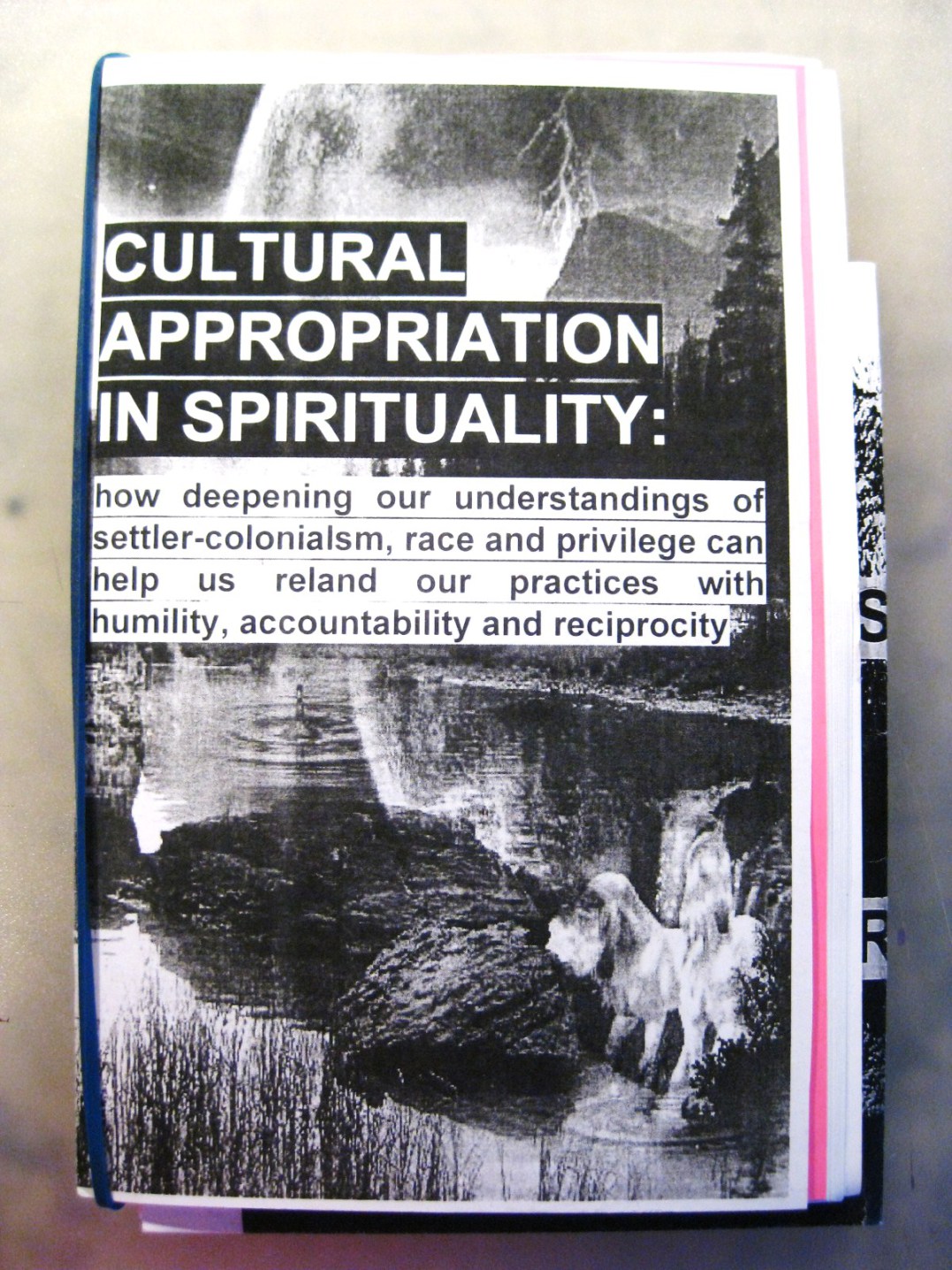


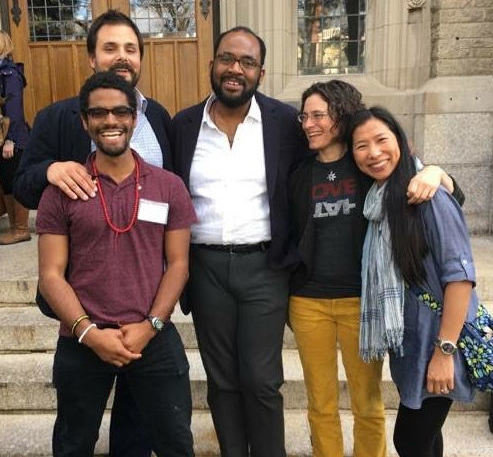
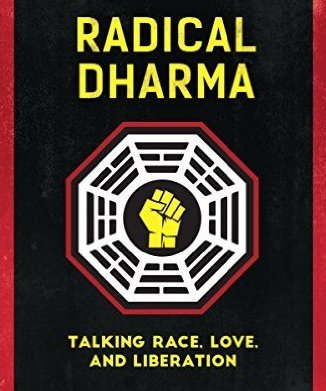
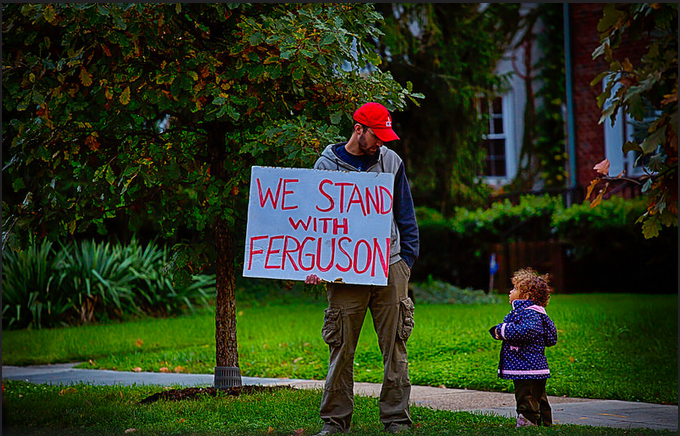
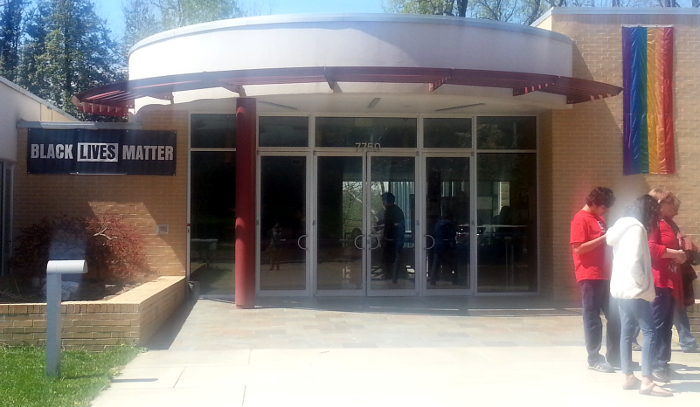
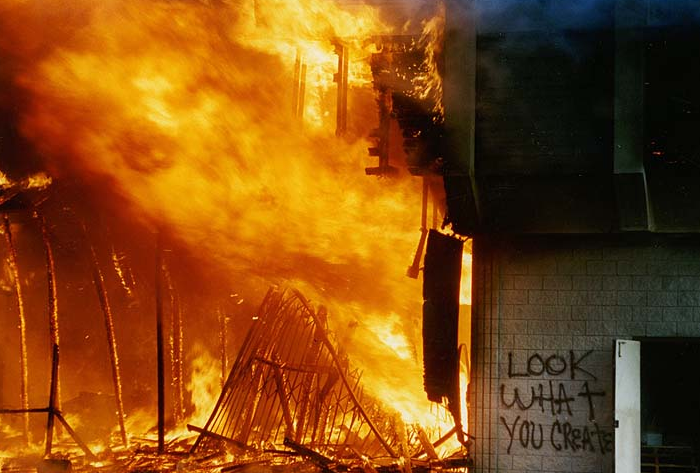
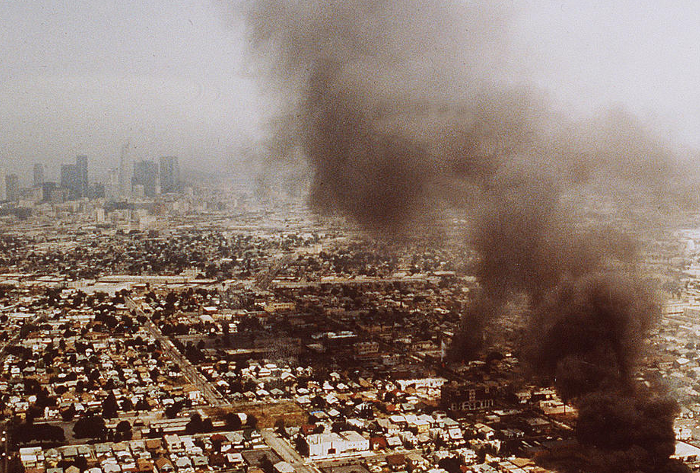
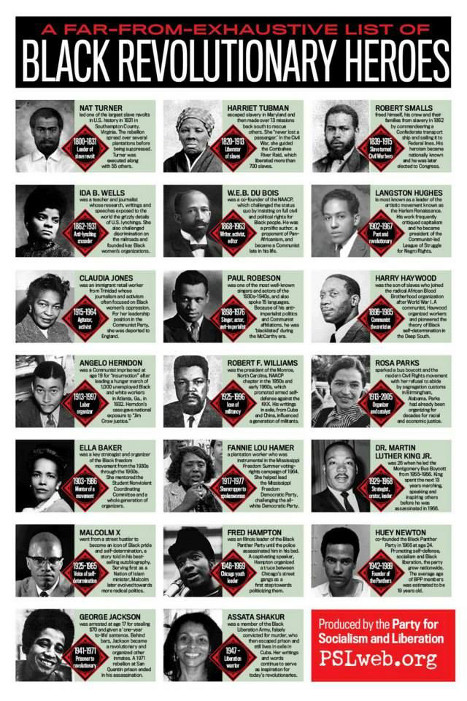

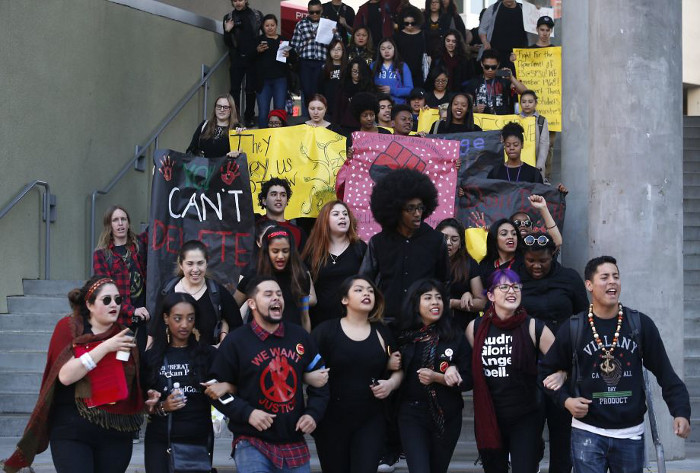
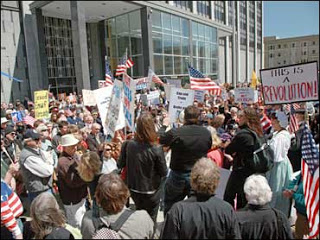

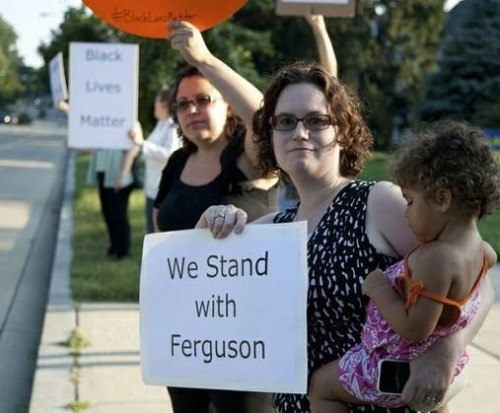
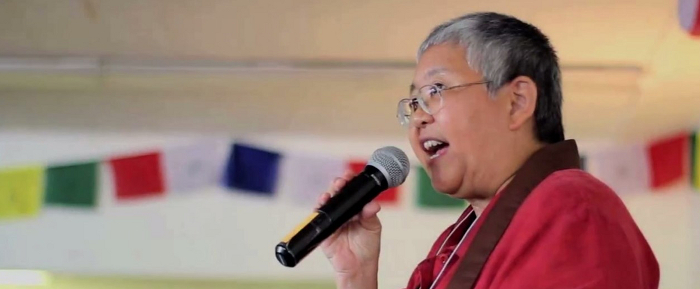
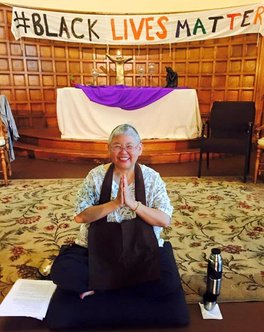
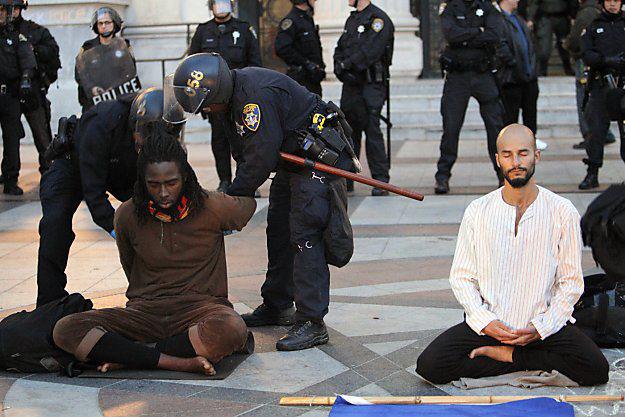
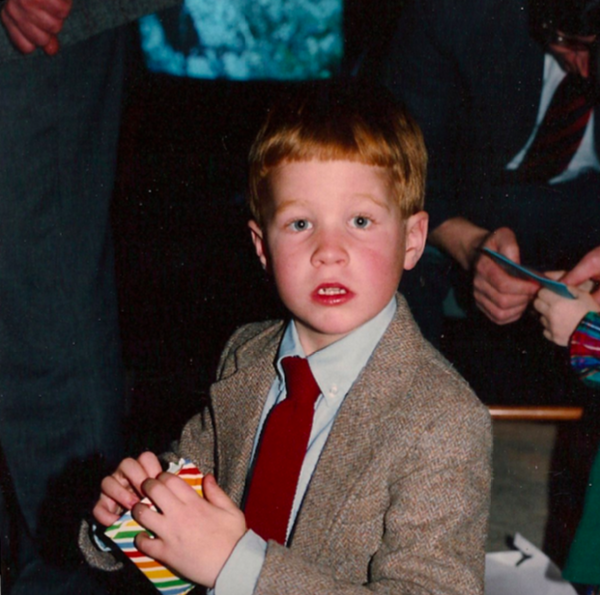
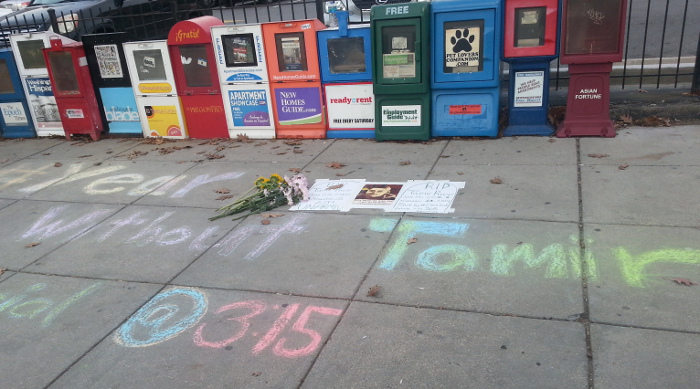
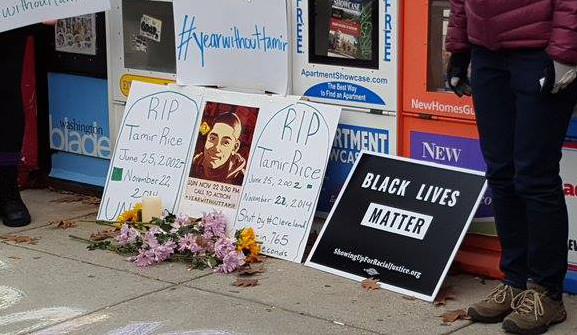
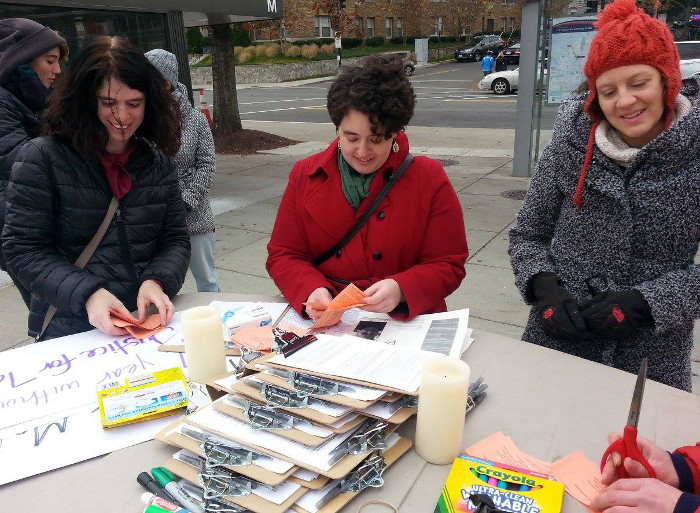
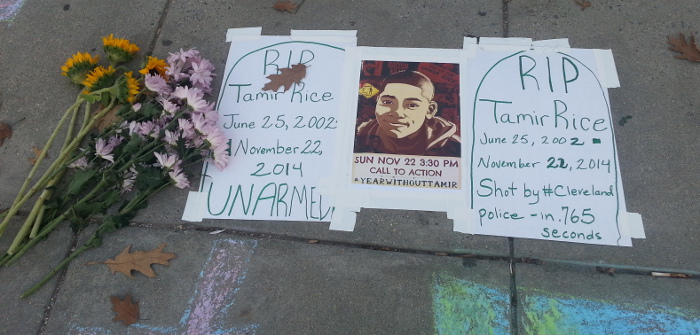
 White Awake